
AFB Incidence Up and Equity Down for New Trust

The first AGM of New Zealand Bee Health and Biosecurity (NZBB) has seen the new Trust report bad news on several fronts – the highest incidence rate of American foulbrood (AFB) in nearly 30 years, an operating loss for the third year running, all alongside the recent news that beekeepers’ per-hive levy is set to increase.

Independent chair Simon Cook led the October 30 online meeting, his first AGM in the top seat, explaining that the process of moving from the former AFB Management Agency, under Apiculture New Zealand, to the trust structure of NZBB was “less than ideal”. Chief executive Niha Long then elaborated on the legal and administrative costs associated with that process, which contributed to an overall loss of $160,000 for the 2025/26 year.
The AFB incidence rate of 0.60% is up from 0.53% the year prior. It plateaued between 2017 and 2021 at around 0.3% but, in-line with the financial struggles of the mānuka honey industry, rose sharply between 2021 and 2024. One year of decline in 2025’s report is now followed by the 2026 lift. (Incidence is calculated by dividing the number of confirmed AFB cases by the number of registered colonies).

Those colony numbers continued to fall, from just over half a million hives a year ago, to now 486,000, while total AFB finds rose from 2601 to 2946.

“0.6 percent incidence. Is that great? It is not,” the chief executive explained.
“It is not a number that I like to see and it is not a number that you like to see either.”
Six regions exceeded the national incidence rate, three of them significantly. AFB was almost twice as likely to be found in Auckland as compared to the national incidence, West Coast a similar result and Taranaki neared 1% AFB incidence.
Conversely, Southland and Otago reported the country’s lowest AFB rates and beekeepers in the Southland Otago Discussion Group, as well as the Whakatipu Beekeeping Club, have asked NZBB to pursue a declaration of a controlled area under the Biosecurity Act. This is expected to be enforced in 2027 and reach into South Canterbury and much of the lower West Coast.

Nationwide less beekeepers reported, or were found to have, AFB, dropping from 589 to 545, while infected apiaries increased by 59 to 1403 nationwide.
“There is a misconception that all beekeepers have AFB, I am here to tell you that they do not,” Long said.

Springbank Honey – “We hope we never have to face that again”.
While the chief executive was careful not to name individual operators, she did point out that “due to one particular beekeeper in the South Island things got really heated, things got really public”.
“I want to acknowledge all the AP2s and my team members who faced quite a significant amount of harassment and verbal abuse. I want to thank the beekeepers who reached out to us with words of support. That meant a lot to us. We know we are in the right and we know you appreciate what we do,” Long said.
MPI provided a $62,000 grant to assist in training certain AP2 hive inspectors in “deescalation” and “to give us operational support in high-risk, non-complaint beekeepers”.
When the floor of the meeting was opened to general business, raised was the topic of Springbank Honey, who had a years-long, public dispute with the Agency and now NZBB regarding AFB levels in their Canterbury business and resulting forced destruction of hives and equipment before being liquidated this year.
“It was certainly a challenge,” Long concluded.
“One that we had never faced and we hope that we don’t have to face that ever again, but we are thankful of your support of us and what we do.”

The Shortfall
That support is most tangible in the roughly $1.2million in levy funds paid to NZBB by beekeepers in an attempt to eradicate AFB from managed colonies in the recent year. It was not enough to cover expenses though, with $111,000 reported as spent on legal fees (up from $31,000 a year prior), contributing to the $160,000 loss.

“That’s not a loss any chief executive or board wants to see,” Long stated.
“It turns out it is not very cheap to establish a new organisation,” she added.
The meeting had previously detailed the process of Apiculture New Zealand hinting at winding-up, which forced a reformation of the AFB Agency last year.
A total of $87,000 was also written off in bad debts – primarily beekeepers refusing to pay levies, or cost recovery charges.
"It does mean we have to pay it off with your levies, if you are being compliant,” Long explained.
The deficit followed losses of $43,000 in 2025 and $103,000 in 2024, putting equity, which entered the 2024 year at $993,000, to now $569,627.
“It is not ideal to be sitting at this equity. When I started it was much higher, but hopefully we will be on the right track going forward,” Long said.

Levy Increase Incoming
Helping to correct that slide is an increase in per-hive levy for the upcoming season, going from $1.95 ex gst in 2026/27 to $2.20 in 2027/28. At current hive levels, that would return approximately $120,000 in increased revenue. Cook explained at the top of the meeting that the board expects hive numbers to be on the increase though after seven years of decline. If that forecast is accurate, combined with the levy increase, there is a roadmap for the NZBB-bee-truck to indeed find the “right track”.
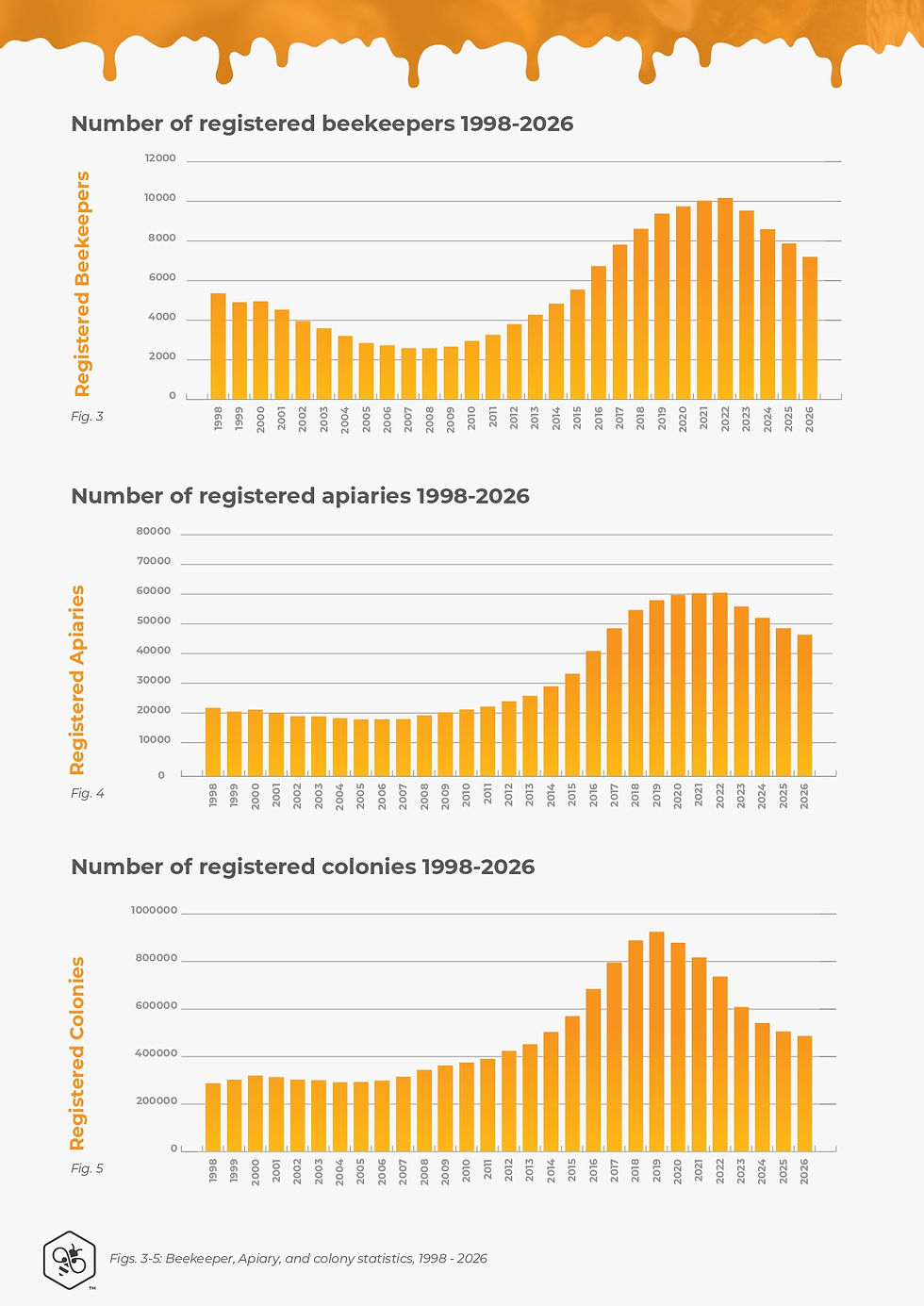
Long reported that, following consultation on the levy increase, 60% of respondent beekeepers agreed with the move, but only 166 of those 6782 registered provided feedback.
“This year we tried a new initiative where trustees were asked to contact beekeepers who owned over 1000 colonies. We tend to not hear from larger commercial beekeepers a lot during these surveys. But, especially with the levy increases proposed, we thought it was important to hear their voices,” Long said.
In all 18 such beekeepers were contacted and the majority supported the increase. Conversely, the majority of beekeepers owning 500-1000 colonies opposed the levy hike that is now on the way for 2027/28.

Building Trust in the Trust
Cook announced that NZBB had received funding from the Honey Industry Trust to fund a part-time external contractor to work on establishing an “early warning indicator checklist and plan for managing a small hive beetle incursion”.
Cook, the most recent past-chair of Kiwifruit Vine Health, explained that similar projects when initially floated in the kiwifruit industry drew concerns of “scope creep”, but that “I hope if we do a good job in the work with small hive beetle then you guys can see the value that can be added by NZBB in this space and we will build enough trust with beekeepers to begin to have an open and positive conversation about the role of wider biosecurity”.
That wider role would be more fitting with the title of ‘New Zealand Bee Health and Biosecurity’ which was coined when moving from an agency operating under Apiculture New Zealand, to a trust in June 2025. The move caused anger among some beekeepers, due to a lack of consultation and that trustees can appoint their successors.

“I understand this caused some concern among beekeepers and I am not comfortable with this myself as it opens up the trustees to criticism about nepotism and ‘jobs for the boys’,” Cook explained.
“I have already started conversations with Honey and Bees New Zealand (HBNZ) about including them in the process and being part of an independent trustee selection panel that will then provide a recommendation back to the trustees.”
The chair also signalled an ongoing closer working relationship between NZBB and the new commercial beekeeper led group of HBNZ, such as he has seen reap rewards for the kiwifruit industry when groups “worked together and supported each other”.
“I will be looking to ensure NZBB and HBNZ operate in a similar manner where we cooperate and work together for the good of all beekeepers.”


Comments