
For Sale: Springbank Honey Assets to Hit the Market

Springbank Honey’s assets will soon be for sale. A recent receivers report into the controversial and embattled beekeeping and honey trading business describes ‘discrepancies’ in asset records and incomplete information provided by the Canterbury company, which is also now the subject of liquidation proceedings undertaken by a beekeeper owed nearly half a million dollars.
A first receivers report into both Springbank Honey Ltd and fellow Brown family farming business Glenburn Green Ltd was released by Teneo Financial Advisory on September 7 which listed more than $12.6 million owed by Springbank, with $9.5m of that due to the first ranking creditor, Bank of New Zealand. A further $9.2m is owed by Glenburn Green, with its primary asset of a 3700ha high-country Lees Valley farm already listed for sale as the receivers seek to recoup money owed.

That farm saw much of its stock, beef cattle, sold by director Stephen Brown as receivership loomed. However, receiver Malcolm Hollis says Teneo were able to intercept those sale proceeds.
Even beyond that, the report released by Teneo paints a troublesome picture regarding accounting for the assets of Springbank Honey, such as honey and beehives.
‘We have undertaken a physical stocktake of the honey held and are reviewing a number of discrepancies identified between the records provided and the stock located’ the report states. Regarding hives, ‘Despite requests, complete information regarding the number and location of the Springbanks’ (sic) hives has not been provided’ Teneo states.

“It’s been a bit tricky,” Hollis says of dealings with the Brown family, with husband and wife Stephen and Tracy Brown owners of both businesses, Stephen director of both and son Max Brown involved in operations.

“We are dealing with people that are not being very forthcoming. We know they are up to things to suit themselves. Stephen Brown has a history of looking after himself,” Hollis says.
Courting Controversy
Springbank Honey first hit headlines in 2020 with Stephen Brown outspoken on the issue of glyphosate levels in their honey. Subsequent media attention contributed to honey trade restrictions being imposed on New Zealand by Japan, which in 2020 represented a $71m market to Kiwi honey sellers. In 2024 Brown courted controversy and sought to rally public opinion against the then American foulbrood (AFB) Management Agency, now operating as New Zealand Bee Health and Biosecurity (NZBB), when he claimed Springbank Honey was unduly targeted for breaches of the Biosecurity Act, pertaining to AFB management in their hives. Then in 2025 numerous beekeepers claimed Springbank Honey had taken their honey and not met payment obligations, leaving claims of millions of dollars owed to a swath of beekeepers.
It was ultimately bank debt which saw the receivers move in though, taking over operations at both Springbank and the Glenburn farm on July 6, but the news was soon to get worse for the once high-flying honey traders.

More coverage on Springbank Honey controversies:
Fire, Fury and a Whole Heap of Hot Air (June 2024)
Springbank Honey Forced to Receivership, Beekeepers Owed Millions, While Brown Family Re-Registers as ‘Springhill Honey’ (August 2026)
The Bitter Sweet Scales of Justice – Springbank Honey Victims Balance Fairness with Forgiveness (August 2026)


From Receivership to Liquidation
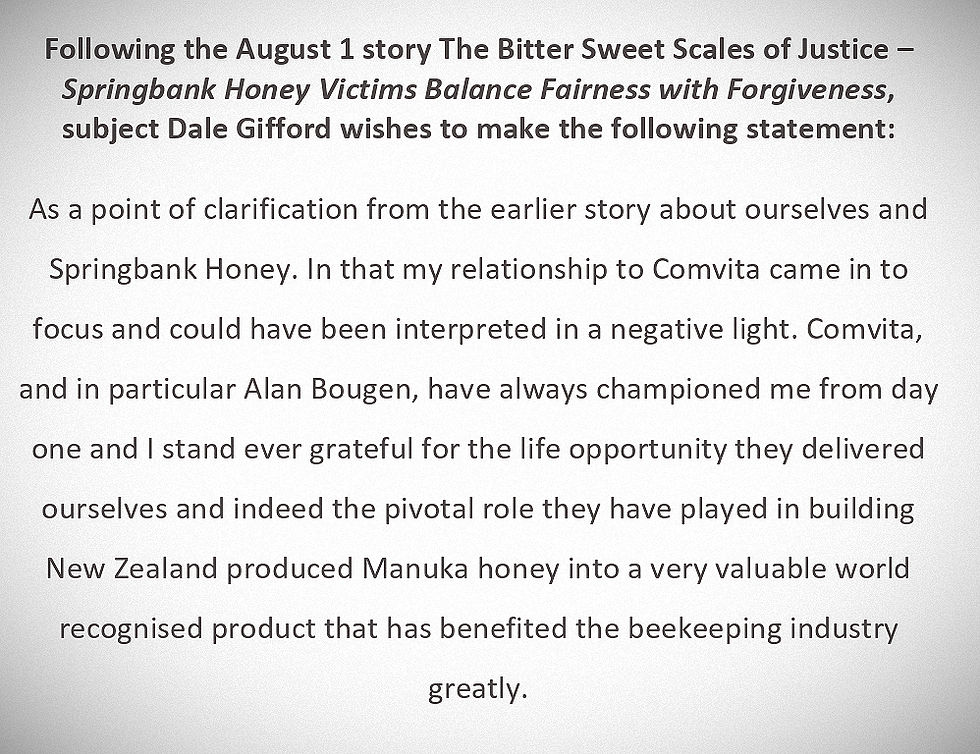
On August 27, Bay of Plenty beekeeper Dale Gifford took proceedings a step further, when the High Court granted his application to liquidate Springbank Honey. Gifford’s plight with Springbank, as well as several other beekeepers claiming to be owed substantial sums, was detailed recently in The Bitter Sweet Scales of Justice – Springbank Honey Victims Balance Fairness with Forgiveness.
Gifford is hoping to recoup nearly $485,000 owed to him, but the receivers report concludes that ‘there are unlikely to be sufficient funds available for a distribution to unsecured creditors in Springbank’. The report states 24 security interests registered against Springbank on the Personal Properties Securities Register and among them are Hillside Honey in Northland, Nelson Honey and the related Rainbow Honey, plus Falcon Apiaries.
Liquidators have greater powers of investigation into a business’s dealings prior to receivership being launched than what a receiver does. However, with the honey that would serve as security for the beekeepers making claims likely not amongst the approximately “15 to 20 tonnes” which Hollis says is held by Springbank, it will be an uphill battle to gain money owed.
The property in Cust in which Springbank Honey is based has a rateable value of $2.21m. While the receivers report lists assets under the titles of ‘plant and machinery’, ‘hive equipment’, ‘honey stock’ and ‘vehicles and trailers’ it withholds their value. With $9.5m of bank debt alone though, there is a wide gap between what the Springbank Honey property is likely to return at an impending sale and what the first in line to be paid is owed.
The Lees Valley farm owned by Glenburn Green, which owes $9.2m, has a rateable value of $6.2m.


Sale Day Fast Approaching
While the Glenburn farm is listed under a deadline sale of September 30, Hollis says he expects agents Colliers to list the Springbank Honey assets for sale around September 20. Already, he says there has been interest from potential buyers.
“A lot of people around the industry are wanting to know. We are getting enquiries all the time, but we have said to people ‘wait till we are ready and then, away we go’,” he says.
“Someone can buy the entire thing, lock, stock and barrel, or they can just buy the land and buildings. Then, someone else may separately buy the plant and equipment or the honey stock. I don’t know. I suspect we will have people wanting one or the other, but it is open to all options.”

He is realistic about the appeal of the approximately 600 beehives and associated equipment, given Springbank Honey’s well-publicised issues with AFB infection in their hives and equipment. All the hives have been cleared for sale by NZBB though, with the Trust’s inspectors having undertaken hive inspections for nearly two years following the cancelling of Stephen Brown’s Disease Elimination Conformity Agreement (DECA).
“It is what it is. They are there and they are available and what people are willing to pay for them, we will just have to wait and see. We are not putting a price on them,” Hollis says.
NZBB chief executive Niha Long says staff at the receivers have accompanied AP2 hive inspectors assessing the hives.

“The hives have all been individually inspected and cleared for sale,” Long explains.
“Those that were not fit for sale have been taken care of in the appropriate manner. What remains is good to go, from an AFB-risk perspective.”
Anyone buying second hand beekeeping equipment and wanting advice on reducing AFB-transfer risk is advised to reach out to NZBB, but in general Long reinforces that best practice is to quarantine second-hand equipment when first used in a new operation.
“Mark the apiaries where the gear goes, wait, and watch and see what happens. If nothing happens, feel free to use it everywhere.”

Closed for Business
Hollis says that an easy decision was made to halt trading at both Springbank Honey and the Glenburn farm soon after they took over operations in July.

“The reality is, it wasn’t trading. When we were appointed there was some honey there, which Stephen Brown was trying to export. I think he had brought it down from the North Island somewhere, but there was no cash flow to buy any more honey stock and blend it. There was no working capital to continue to trade. So, we didn’t. We shut it down after a few days.”
Attempts were made by Brown to continue to operate by buying back honey, or leasing back the Cust facility, but both were swiftly rejected by the receivers Hollis says.
As for the emergence of ‘Springhill Honey’ operating out of the same address and using the former Springbank Honey Facebook page with 13,000 followers, plus redirecting the former www.springbankhoney.com website to www.springhillhoney.co.nz, Hollis says that, in his line of work, that sort of activity is called a ‘phoenix’ company.
“Is it a pain for us? Maybe. It is pretty small beer as far as I can tell. It is certainly Max Brown trying to set himself up in business. Whether it is of any great substance or activity, I don’t know. I don’t think he will get any support from anyone in the industry to sell him honey,” Hollis says.

Long Time Coming
When it comes to describing the nature of the Brown family’s dealings with the receivers appointed to run their businesses, Hollis chooses his words carefully.
“The Browns are obviously disappointed about what is going on and, in terms of them assisting us, it has been modest at best,” the receiver says.
His dealings with the Canterbury company have amounted to just over two months’ worth of work though, whereas for Gifford it is more than two years since his honey headed south and almost that long he has been left out of pocket. He says he expects it to be one or two years more before he gets any resolution – good news or bad – from the liquidators.
“These things take time. I am learning that,” the now retired Bay of Plenty beekeeper says.

Time is what NZBB has had to spend on dealings with Springbank Honey, and money too, with Long confirming they are on the list of unsecured creditors owed money from various actions taken in the last two years.
“We have to get in line, like everyone else,” Long says, but adds that previous dealings with businesses in receivership have not seen NZBB paid, thus costs have to be picked up by the rest of the beekeeping industry which funds the Trust.
The remaining beekeeping assets of Springbank Honey are likely just weeks away from passing into new ownership, or being destroyed, thus bringing to an end a business running high on hype but low on support amongst fellow beekeepers. It’s also a potential conclusion to the highest-profile attacks the AFB Agency and Trust has ever seen, with Long surely not alone in her succinct summary of the saga – “It’s been exhausting”.


Comments