
Hornet Champions – Why the Fight Isn't Over Yet
While yellow-legged hornets have disappeared from sight for winter, New Zealand's response isn’t over yet. Biosecurity New Zealand and the bee sector are now turning their attention to keeping awareness alive, launching a proposed Hornet Champions network to help ensure vigilance doesn't fade before eradication can be declared.
By Eloise Martyn
The initiative, modelled on the UK's successful Hornet Action Groups, aims to recruit respected beekeepers to act as local champions, sharing accurate information, encouraging reporting and helping prepare communities should hornets reappear. It is a timely reminder that eradication requires more than finding and destroying nests – it relies on people remaining alert for years.
The exact nature of what the proposed Hornet Champions’ work would entail and who would be appointed to such roles is yet to be confirmed, but Biosecurity New Zealand is keen to get the beekeeping community’s thoughts on the approach.
The concept was reinforced during a recent Auckland Beekeepers Club webinar, attended online by 33 participants, featuring UK bee health specialist and beekeeper Dan Etheridge. Etheridge spent more than a decade with the UK's National Bee Unit (NBU), where he played a key role in the country's response to the yellow-legged hornet (commonly known in the UK as the Asian hornet). He also travelled to New Zealand to assist field teams during Auckland's recent yellow-legged hornet response.

One message stood out clearly: beekeepers are among the most valuable tools in the response.
"Beekeepers have been invaluable," Etheridge said, describing how UK beekeepers report sightings, monitor bait stations, trap hornets and raise awareness through schools, garden clubs and community groups. Their involvement has become an essential part of UK’s long-running response.

The UK's system receives around 20,000 public reports each year. Suspected sightings are assessed before specialist field teams track hornets back to their nests, with separate teams responsible for destroying them. Tree surgeons have also become indispensable, with many nests located more than 20 metres high in mature trees.

Technology has transformed the response since the first hornets arrived in Britain in 2016. Etheridge highlighted an impressive technological toolbox that includes ArcGIS a complex mapping system, Dutch-developed radio trackers, and Atrifical Intelligence-powered camera systems capable of automatically detecting hornets. However, he was quick to emphasise that technology tools are supplementary, rather than a replacement, for the fundamental methods of locating, tracking and eliminating hornet nests.

"The primary method is still baiting, timing and triangulation," he explained. Inspectors capture hornets, mark them and carefully record their flight direction and return times, gradually narrowing the search area until the nest is found. Even gluing a tiny strand of glittering party tinsel to a hornet has proved surprisingly effective for keeping insects visible during tracking.
Despite the impressive technology, Etheridge repeatedly returned to the importance of teamwork, persistence and community involvement.

There was encouraging news for New Zealand too.
Asked whether yellow-legged hornets could be eradicated here, Etheridge didn't hesitate.
"I think the short answer is ‘yes’," he said. "You've already shown you're in a good position to do so. It's a completely different situation to the UK."

He praised Biosecurity New Zealand and SPS Biota's response as "outstanding", saying the speed with which nests had been located had given New Zealand a significant advantage. He also noted a key difference between the UK and New Zealand. While some yellow-legged hornet nests are found in residential areas in the UK, the majority are located in the rural countryside with relatively little surrounding development. In contrast, Auckland's landscape of interconnected urban parks, reserves and residential, where hornets were found, presented a different set of surveillance and response challenges. He was particularly struck by Auckland’s high concentration of nests, with many found close together despite most nests being small and weak.
Etheridge warned, however, that winter should not breed complacency. Based on temperatures and daylight hours, he expects hornet queens could begin emerging from mid to late September. His advice to beekeepers is simple: watch for the first common wasp queens.
"As soon as I see common wasp queens emerge, I know the hornets aren't far behind."

The complacency message aligns perfectly with the proposed Hornet Champions programme. The proposed programme is seeking respected beekeepers from around New Zealand to act as local Hornet Champions. Their role will be to share accurate information, encourage reporting, help keep awareness high within local clubs and communities, and support preparedness should yellow-legged hornets be detected again. Beekeepers are also encouraged to have their say on the proposed guidelines and nominate suitable champions in their region.
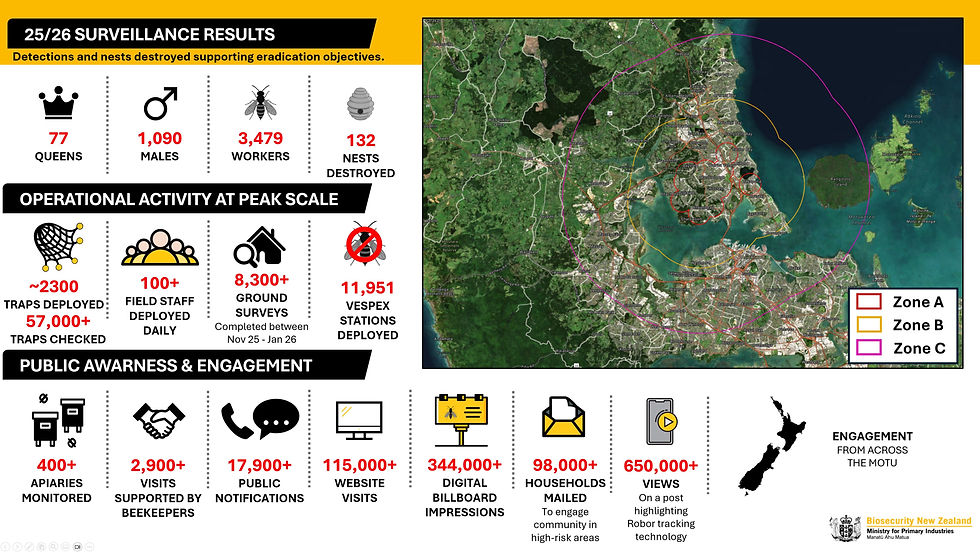
With 77 queens and 132 nests removed and no confirmed detections since early April, New Zealand has made extraordinary progress. But confirming eradication requires two consecutive seasons with no hornets detected.
The next phase of the response will depend less on field crews and more on informed, connected communities. If the Hornet Champions initiative succeeds in keeping awareness high, it may prove just as important as any piece of tracking equipment in securing New Zealand's victory over the yellow-legged hornet.
Registered beekeepers should have received an email from New Zealand Bee Health and Biosecurity regarding Hornet Champions on July 22. More information can be obtained by emailing info@nzbb.org.nz


Comments