
Hornet Response – A View Beyond Auckland Needed, and Beekeepers Implored to Act Now
- Patrick Dawkins

- Jan 4
- 7 min read
As a yellow-legged hornet (Vespa veluntina) biosecurity incursion response winds into month three, the Ministry for Primary Industries (MPI) is simultaneously being praised by the beekeeping community for an expansion of their response funding and front-line efforts in Auckland and encouraged to provide longer-term contingency planning with a view to the invading insect being found elsewhere. The clock is fast ticking on eradication hopes and critics say the beekeeping community and general public need to be better rallied to assist in the fight.
While male hornets were first detected in the suburb of Grafton in Auckland’s city centre in late-June 2025 and soon after in Albany, the official response ramped up following the October 17 find of a queen yellow-legged hornet in the early stages of nest-building on the North Shore.
Since then more than 7500 public notifications have been received by MPI and their offshoot agency Biosecurity New Zealand to investigate, while intensive trapping, inspections and information pamphlet drops have taken place in Auckland.
As of December 30, 39 queen hornets, 26 of which had begun nest building, had been located and destroyed – all within “Zone A” which has been subject to intensive trapping out to 1km around detection sites. Beyond that “Zone B” extends trapping to 5km and, as of late December, a “Zone C” out to 11km from the centre point of Glenfield and Birkdale has been implemented. All up 780 traps have been placed, the majority in Zones A and B while owners of 575 apiaries within Zone C are being asked to closely observe their beehives.

On December 19 a Christmas bonus arrived when Biosecurity Minister Andrew Hoggard announced the government would commit $12million to cover the response up until June 2026.
Some cost-sharing is taking place with industry groups from the horticultural sector that have pre-set biosecurity Government Industry Agreements and, while the beekeeping sector doesn’t have such an agreement, several groups have been engaged as part of the response without committing funds.

One of those groups is New Zealand Beekeeping Inc (NZBI), who have been privy to MPI’s draft contingency plan and whose advisor Ian Fletcher has supplied the response leadership with an eight-page advice document from a commercial beekeeping perspective. In it MPI is asked to ‘shed the lone hero persona’ and that they ‘must expect and receive full-throated community and industry support’. It outlines early detection of any hornet spread to new urban, rural or conservation estate areas as essential.

“It is an attempt to get MPI to think more longer-term and nation-wide about the response,” Fletcher says of the advice document.
“We are yet to see a response which is commensurate with the challenge. They need to think longer-term. You have to have a plan that extends to 2027, which is a huge resource commitment and therefore MPI has to build a wider partnership to manage that.”
To be best prepared for potential hornet spread to a rural area, or areas, a ‘national beekeeper surveillance network’ needs to be established with beekeepers providing trapping, observation, reporting and potentially some response capability if needed, according to Fletcher and NZBI.

Apiculture New Zealand (ApiNZ), along with NZBI and the American foulbrood management agency New Zealand Bee Health and Biosecurity (NZBB), has formed the national-level beekeeping representation to MPI during the response, but NZBI has refused a non-disclosure agreement with the government on the issue, limiting their involvement but providing greater ability to publicly speak out on the matter.

“Contingency planning is the next step,” says ApiNZ chief executive Karin Kos.
“We are still working through what the worst-case scenario is and how we prepare.
“There is a lot of interest from beekeepers and at this stage liaisons have been with hobbyists because the incursion is centred in an urban area. But the next step is, what needs to be considered across the rest of New Zealand?” Kos says.

“Clearly there is a role for beekeepers to play and we need to consider what changes over the season … it is all in the planning at this stage.”

Taking the Hornet by the Horns
Not prepared to wait, some beekeepers are calling on their fellow apiarists to take action now, even if it is not yet formally organised.
“I think every beekeeper on every site should make a home-made trap and set it,” says Bay of Plenty commercial beekeeper Richard Klaus.
“They should also be observant of apiary sites and, before they drive in to work it, stop 20 metres before it and look to see if any behaviour has changed. Be observant. If one of these things has travelled, we need to eradicate it now. It could have gone on a pallet from Auckland to Invercargill on Mainfreight.”
Klaus says he is putting his money where his mouth is too, with traps at all his apiaries, plus some other locations, and is in the process of making contact with transport operators and orchards in the Bay of Plenty asking them to trap for hornets, having been working closely with Zespri as a pollination advisor through spring.
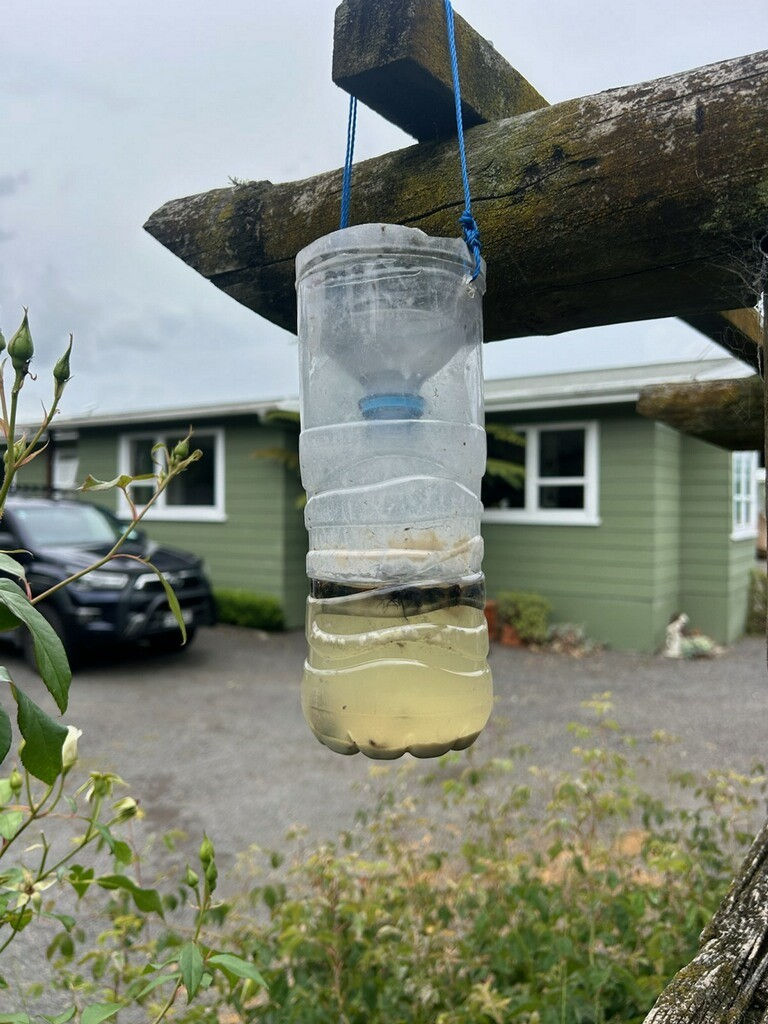
Both ApiNZ and NZBB have circulated advice on how to make and set traps, plus observe hives for ‘hawking’ – the process of hornets preying on honey bees on the wing near hives.

The risk to beekeepers’ livelihoods posed by the hornet should be sufficient motivation for apiarists all over New Zealand to act by setting traps now, in the crucial months before hornet queens mate again heading into winter, Klaus says.
“The clock is ticking and we have about 70 more days to find them. If one has travelled, with a capital ‘IF’, then if we all set a trap, we can find it before there are 400 next year.”
Boosting the Public Profile
A beekeeper response is one thing, but gaining the assistance of more of New Zealand’s population of five-million-plus is essential says another commercial beekeeper in the Bay of Plenty – a region where any impact to bee health could seriously impact the local, and by proxy national, economy due to the heavy reliance on kiwifruit orchards and their insect pollination.

“People in the bee fraternity know where to go and look, but I have asked others if they know where to go and they say ‘no’,” Grenville Ormsby says of MPI’s yellow-legged hornet website.
“It should be promoted better to the general public. Promotion to the bee community is not enough. Somebody needs to stand up and say how serious this is. I know beekeepers in France who say they got devastated by this hornet within two years.
“I don’t doubt what they are doing in Auckland is a good job, but I worry they are not giving enough information to the general public. Don’t keep it in house with the beekeepers.”
Ormsby says he has approached MPI with these concerns and is encouraging various politicians to take a public lead on boosting the profile of the matter.

Ormsby, Klaus and NZBI’s advice all centre on the same concern, that the response needs to simultaneously continue its focus on Auckland while increasing surveillance and preparedness across the rest of the country because the risk of not doing so is simply too high.
On the Ground in Auckland
Members of Auckland Beekeepers Club have played a role in the response so far, by helping educate the general public in Auckland and some members assisting the response team in setting traps and carrying out inspections.
“The hives will be a magnet to the hornets so they are asking all beekeepers in Auckland to spend at least 20 minutes a week observing the hives for hawking,” club president Ken Brown says.

“They still haven’t been found outside of the Glenfield area, but assuming they have moved then we will be able to find it (in the expanded zone).”
Hornets are being painted with coloured dots and tracked back to their nests, while radio-transmitted tracking technology is expected to be implemented in January and beyond. While beekeeping clubs and groups outside of the Auckland club are not being formally organised to respond, Brown’s advice is to be ready.
“I believe in the system. I have travelled around the world and New Zealand is the least corrupt place and a place where biosecurity is so important. I think other groups should trust in the system and work within the system, but make suggestions where they think they are needed.”

Some are making those suggestions already, and Fletcher says he expects to meet with response leadership in the first half of January to promote his advice around a more organised plan for urban, rural and conservation estate preparedness for the hornet, and better utilisation of beekeepers.
Klaus is putting himself out there to numerous industries and media platforms to stress the need for greater trapping surveillance, countrywide, now.
“I hope it is nothing and I hope everyone laughs at me but, if one has travelled, we could have 400 of these things somewhere new,” Klaus says, adding “I have lived through varroa and I don’t want to live through something like that again, with all its ongoing issues”.
Key Resources
Looking for yellow-legged hornet nests: Beekeepers’ guide to surveillance – Fact sheet [PDF, 487 KB]


Comments