
Queen Breeders Feature

ADVERTISING FEATURE: QUEEN BREEDERS
It’s fast getting to that time of year again, when hives are being opened for the first time coming out of winter – a winter featuring New Zealand’s warmest June on record. Many beekeeping tasks await in the next few months, but prime among them is ensuring the queen at the heart of each colony is fit to perform.
With that in mind, we thought it prudent to take this time in late-winter/early spring to create a space where those at the helm of some of New Zealand’s leading breeding programmes can provide further details to inform what each of their businesses is about. We ran an equivalent feature in 2024 and figure every second year is prudent timing to keep the industry abreast of the leading queen breeding businesses serving beekeepers.

Whether it is the biology and mechanics of the breeding programmes themselves, the people calling the shots, or what’s on offer, it’s all good information for beekeepers to consider if they are ‘in the market’ for queens, cells, or nucs.
Come spring there can be a lot of people looking to sell queens, all of varying levels of dedication, skill, experience and expertise. So, we hope this feature can help potential buyers make informed choices around what they are getting from a breeding programme, and who they are dealing with.
Afterall, successful beekeeping is not just about getting the hive queen-right, but with the right queen for your needs.
*This is an advertising feature – all copy, advertising and text, is supplied by the advertisers.
Chatham Gold – Chatham Islands
From the Chatham Islands a new type of queen is coming to New Zealand, one bred 44° south in isolation.
For many years, Toni Croon of Chatham Gold has quietly worked with her bees in one of New Zealand’s most remote and remarkable places, the Chatham Islands, and now she is sharing them with the rest of New Zealand.
Toni has strategically placed all her hives in carefully selected locations across the island, giving her bees’ access to the very best of this unique disease-free, wasp-free environment.
In many ways it’s a charmed life, varroa-free, American foulbrood-free and wasp-free.
“It’s embarrassingly easy to be a beekeeper,” Toni says “as long as the bees face north, sheltered from south west winds they flourish.”
Over the years, Toni has come to know her bees, her hives and the lay of the land. Her passion and dedication can be tasted in Chatham Gold’s clover honey. Toni has hives in Peat Wetlands which are producing her Heather Honey. But for Toni, the journey has never been just about honey.
The business is beginning a new chapter, having established a large new bee shed and home, she is ready to turn her attention to the exporting of queens, nucs and package bees which are all transported to New Zealand via a four-hour air-freight to Auckland, Wellington and Christchurch.
The Italian-type bees are grafted on performance because behind every strong hive is a strong queen.
From a tiny island something special is taking flight.
“Isolation has its downfall but, when it comes to bees, being 800km east of New Zealand has been a God send,” Toni says.

Mana Queen – Marlborough
Mana Queen was shaped by decades of beekeeping experience across different climates, islands and continents.
Founder Raf Augustyn graduated from the Secondary Technical School of Apiculture in Poland, the only specialist school of its kind in Europe, earning the official state title of Technician Beekeeper after four years of technical education. His beekeeping career now spans 25 years across Europe, North America, Asia and Oceania.

His experience covers continental, northern, tropical, subtropical and maritime conditions, as well as island environments including Great Britain, Hawaii, New Zealand’s North and South Islands, Matakana Island, and now Arapaoa Island.
In New Zealand, he worked across Northland, Wairarapa, Waikato, Marlborough and the Sounds, establishing three operations from the ground up: a queen unit within Kiwi Bee’s Waikato honey business, King Honey’s combined Marlborough honey and queen operation, and finally Mana Queen, focused primarily on queen breeding alongside a premium certified organic honey operation.
Mana Queen carries around 1,000 mating nucs through winter and expands to 2,500 units at the height of the season. A further 100 certified organic production hives form the drone-stock foundation of the breeding programme. This scale supports commercial production while maintaining a large population for ongoing breeder selection.
The operation supplies queen cells and mated queens throughout New Zealand. The programme is focused on steadily improving disease resistance and mite tolerance with each generation. The strongest breeder queens are retained within the population, while other outstanding breeder-class queens are made available to the wider industry.
Export queens are produced during the second half of the season, with Canada currently the principal market. As overseas interest grows, Mana Queen is working to develop further pathways for New Zealand queens into international markets.
Breeder selection begins with a large, genetically diverse population of overwintered queens. The wider the testing base, the better the chance of finding individuals that stand clearly above the average while preserving the diversity needed for future progress. Each queen has already demonstrated her ability to overwinter and is then evaluated for performance before the next generation is selected. This annual cycle of testing, comparison and selection is demanding, but it provides the depth needed to make genuine progress without narrowing the population too quickly.
The objective is not simply to produce more queens. It is to improve the population first within Mana Queen, then carry that progress into commercial operations through queens, queen cells and the drones their colonies produce.

ApiLife Ltd – Wairarapa
At ApiLIfe the mission is simple: To provide superior honey bee genetics for future generations. Of course, any beekeeper knows that achieving such gains is anything but simple, but owner Jaime McRae says they are committed to the task and dedicated to working alongside beekeepers to make it happen.
“That starts with breeding both Apis mellifera ligustica (Italian honey bee) and Apis mellifera carnica (Carniolan honey bee),” McRae explains.
“This gives us an advantage over most queen suppliers who only choose to supply either Italian queens or Carniolan queens. We have invested a vast amount of time and funding in sourcing queens from breeders all over New Zealand and we monitor these queens over a full one-year period before we introduce any new genetics to our pools. We look for genetic diversities we can include in our genetic lines, including production and hygienic behaviour traits, temperament, vigour, winter survival rate, Varroa Sensitive Hygiene (VSH) traits, and reduced swarming behaviour.”

New Additions
The family owned and operated beekeeping company, located in the lower North Island, mixes commercial beekeeping experience with a scientific approach. This has included introducing artificial insemination to the breeding programme in an attempt to enhance and speed up genetic gains.
“A key consideration in ApiLife’s queen selection is increasingly varroa tolerance and hygienic traits. Therefore, both the Harbro assay and UBeeO testing is being utilised to allow selection of genetic traits which improve the overall health and resilience of the honey bee population,” McRae says.
Assessing the Results
Careful assessment is made of every queen before it enters the cage at ApiLife and queens are also left in their hives for a minimum of one month before being caged and sent to customers.
“This ensures that the queen is performing well, allows enough time to highlight any potential issues that an individual queen may have, and allows time for her to produce the right level of the five known pheromones,” McRae says.
“These pheromones play a crucial part of requeening. If the queen lacks certain amounts of each pheromone the hive may not accept her in to the new colony.”
Encouraging Others
With the mission to improve honey bee genetics for future generations, ApiLife also supplies Artificial Insemination equipment to fellow beekeepers should they wish to utilise the technique themselves.
As spring approaches, McRae advises beekeepers to get a plan for the coming season and their queen supply in place early. ApiLife have sold out of over-wintered queens already, and even the early spring rounds, but there is still space later in the season.
“We are gearing up for another full-on production season and there is still opportunity for mated queen orders in the new year and even for those who want to register interest for the following season. I look forward to hearing from beekeepers.”

Bee Smart Breeding – Ashburton
At Bee Smart Breeding Rae Butler taglines her breeding programme “the right direction”. That’s because it leads the way in breeding bees for Varroa Sensitive Hygiene (VSH), combining varroa resistant breeding with maintaining the sort of traits commercial beekeepers value – honey production, overwintering ability, temperament and colony health.

The Bee Smart Breeding programme collaborates with a Canterbury beekeeper with more 1,000 colonies which are screened for VSH and selectively bred through open mating. The ten-year program has consistently achieved honey yields with minimal winter losses, while requiring only two annual varroa treatments.
A range of varroa resistant queens of various grades are available, dependent on VSH level, seasonality and source and what other services from Bee Smart Breeding are required.
And it is these other services that further set Bee Smart Breding apart. Butler has trained under some of the world’s leading VSH experts and spent 15 years on the task of breeding for varroa resistance. Now it is not simply a matter of sharing those genetics through sales of mated and virgin queens, plus queen cells, but helping promote genetic improvement by providing education and services to assist.
“The aim is to encourage beekeepers to work alongside their queen breeders to identify varroa-resistant colonies within their own apiaries and breed from them. Whether through open-mating, drone saturation, isolated mating or instrumental insemination, breeding systems can be tailored to suit individual operations,” Butler explains.
“As more beekeepers select for these traits, favourable genetics become increasingly common within local drone populations, strengthening future generations of bees while maintaining genetic diversity.”
Bee Smart Breeding supports this journey through VSH-tested breeder queens, production queens and queen cells, Harbo VSH assaying, instrumental insemination, semen collection, breeding programme development, consulting and training. Services are available on-site, at the Ashburton facility, or through brood frames and bee samples submitted for assessment.
Currently in the midst of leading a winter tour of workshops titled “Breeding for Varroa Resistance” hosted by the Bee Breeding NZ Group which she founded, Butler is putting in the work to not only advance the VSH genetic profile of her own Bee Smart Breeding stock, but across the country.
“Working together, we can build healthier, more resilient bee populations and help shape a sustainable future for New Zealand beekeeping,” she says.
That’s why it’s the right direction.

Kereru Queen Bees Ltd – Hawke’s Bay
Nestled in the foothills of the Ruahine Ranges, three sisters and their families operate Kereru Queen Bees – a queen breeding programme that has been AFB free for over 40 years.
Their Bee Team manages 1000 hives in Kereru, rural Hawke’s Bay, including over 100 specialised breeders and cell raisers. Breeder queens are selected for desirable traits such as top honey production, hygienic behaviour, friendly temperament, pollen collection and overwintering success.
“We have been advancing these genetics even further by evaluating our best queens for Varroa Sensitive Hygiene using methods refined by Rae Butler," says apiary manager Amy Dunn.
”It is exciting to see positive results and we consider the time and effort it takes to complete the VSH testing worth the investment.”

Their long-term goal is to breed bees that are more resistant to varroa, thus reducing the number of mite treatments needed. The majority of their hives are now organic.
Before grafting, larvae are assessed for optimal age and royal jelly, and before sale every cell is checked for virgin size and quality. Large mating nucs are used in which each queen can lay up to 9 standard ¾ depth brood frames. Quality is paramount, hence why queens are left in their hives for at least four weeks so their capped brood can be examined before sale.
“We prefer using larger nucs,” Amy explains, “because we can more accurately assess laying patterns, brood quality and hive health. We use supers on our mating nucs so excess honey can be harvested, while also leaving good stores for them to overwinter strongly.”
Building upon the legacy of their father John Dobson – creator and manufacturer of the iconic Carricell portable incubator – the sustainability of Kereru Queen Bees Ltd stems from the high quality of their queens, customer satisfaction and word of mouth.
“I think word has gotten around that we focus more on quality than quantity so many of our clients are booking 1-2 years in advance!” says Amy.
As such all their overwintered queens for this spring are fully booked with a waiting list. They still have some availability for later spring and summer mated queens, and queen cells (available from early September through until end of March).

Lion Apiaries – Auckland
For almost 20 years Lion Apiaries have been serving New Zealand beekeepers, and because they’re commercial beekeepers, they understand that buying queens isn't simply placing an order – it's part of a season that's constantly changing.
While they carefully select the queens they breed from, owner Dallas Russ says they also recognise that open-mated queen production is about balancing selection with maintaining the genetic diversity needed for healthy, productive colonies.
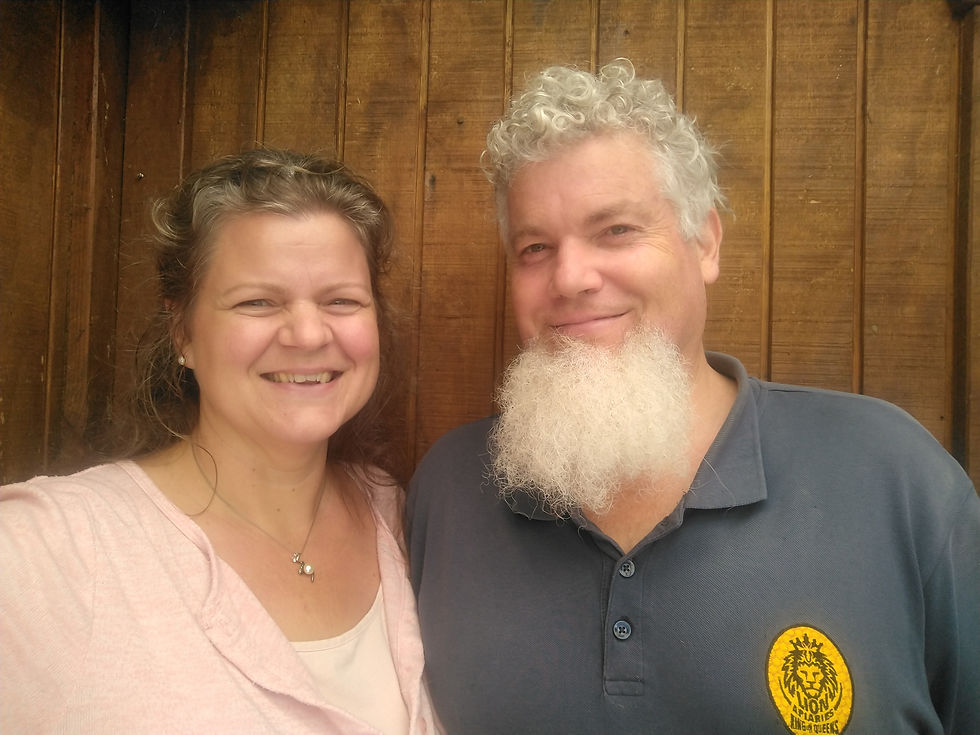
“Producing quality queens at commercial scale isn't about chasing the narrowest genetic line, it's about consistently producing queens that perform well for beekeepers season after season,” Russ says.
“The queens we select are the ones that prove themselves where it matters: they establish quickly, build strong colonies, remain pleasant to work, and keep performing through the pressures of a commercial season. Those practical traits guide every breeding decision we make.”
The Lion Apiaries queen production programme has grown over many years and now operates thousands of mating units each season. Managing a programme at that scale requires careful attention to both queen quality and genetic diversity, ensuring reliable queens continue to be produced without compromising the long-term strength of stock.
“Just as important to us as the queens themselves is the service behind them,” Russ explains.
“Beekeeping rarely goes exactly to plan. Weather changes, honey flows shift, pollination contracts move, and suddenly the number of queens you need isn't the number you ordered. We understand that because we live it too. Wherever possible, we'll work with you to adjust your order and help you make the season work.
”At Lion Apiaries the mantra is not to simply supply queens, but support fellow beekeepers.
“Whether you're managing thousands of hives or buying your first few queens, our aim is the same: to provide honest advice, dependable service, and quality queens you can buy with confidence.
“We believe good queens are the result of consistent selection, sound management, and experience, not exaggerated claims. We also believe good business is built on relationships. We're here to serve New Zealand beekeepers, and we'd be honoured to be part of your next season.”

Kiwi Queens – Tasman
Growth through the acquisition of fellow beekeeping enterprises has brought more than just additional hives to the Goldsworthy Apiaries operation. It has also expanded the genetic diversity available to the Kiwi Queens breeding programme in the Tasman region.
“There is no shortage of new genetics to choose from in our wider operations, which provides robust and high-quality bees,” says owner Matthew Goldsworthy.

Kiwi Queens operates as a specialist breeding arm of the wider Goldsworthy Apiaries business, which Matthew and Sarah Goldsworthy have steadily expanded across the upper South Island through the acquisition of several beekeeping operations in recent years.
The breeding programme focuses on Italian-style queens — “the more pure, the more golden, the better” — with high honey production, calm temperament and strong overall performance forming the key selection criteria. Kiwi Queens supplies mated queens, virgin queens and nucleus colonies to beekeepers throughout New Zealand.
While Goldsworthy Apiaries hives are spread from the West Coast through Tasman and Nelson to Marlborough, the centre of the Kiwi Queens breeding programme remains in Tasman, where the operation’s best-performing colonies are relocated.
“We select our top three or four percent of hives and they don’t all become our breeders, but we bring them in to be our cell-raising finishers. That allows us to look through them more often and harness the genetics to raise the cells and create good healthy bees and quality queens,” Goldsworthy explains.
The business also benefits from isolated mating locations situated within forestry blocks, helping maintain strong control over drone populations and breeding outcomes.
Virgin queens are supplied to some customers and are also used internally when queen cells are not utilised in time. Goldsworthy says the approach has delivered strong success rates. Nucleus colony production is another important part of the Kiwi Queens operation.
“The nucs are generally summer-mated and we set them up through the honey flow and carry them over winter. The season is then so early over here that we can supply good nucs in August and early September — three frames of brood and five of bees. Good, solid, strong early units.”
Since launching in 2020, Kiwi Queens has grown to supply thousands of queens to beekeepers around the country. With demand continuing, Goldsworthy sees further opportunities for expansion.
“We are excited about the potential growth of the industry and we want to grow with it, so that will mean increasing our queen supply and our nuc supply.”

Pyramid Apiaries – Marlborough
Performance, Reliability and Commitment are the three qualities that drive Pyramid Apiaries breeding programme in Marlborough, supplying mated queens throughout New Zealand, queen cells for local pickup and nucs for whoever needs them.
Performance
Performance of queens is key, with selection of breeding queens coming from the top performing honey producers which then over-winter strongly. Like most breeding programmes, hives with poor temperament are ruled out. Italian-type bees are sought by selecting on colour where possible, such as ruling out hives with a high proportion of black drones. However, attributes that are more likely to boost productivity are prioritised over colour.

“The laying ability of our mated queens is also closely assessed, with all of our queens mated in full-depth units which provide good opportunity to evaluate their production ability before being caged and supplied to beekeepers,” owner Laura Dawkins says.
Reliability
Pyramid Apiaries’ goal is not to be the biggest supplier of queens or nucs to the industry, but the most reliable.
“We work with some regular core clients to provide them with queens, cells or nucs and we really enjoy effectively being their business’s queen breeding unit. We take this job seriously, doing our best to supply orders when the beekeepers need them. Communication is key, and understanding and working in with our fellow beekeepers is hugely motivating for us,” Dawkins says.
Commitment
Pyramid Apiaries work is almost all carried out by husband-and-wife owners Patrick and Laura, with casual staff, albeit skilled and experienced, used only infrequently.
“We find the whole process of running a breeding programme enjoyable, so are committed to ensuring the end results – the queens, the cells, the nucs – are top-notch.”
While many of the Pyramid mated queens are booked out in spring, there is still opportunity for beekeepers to snap some up in late spring and through summer, if they preorder. Nucs are also selling fast, so beekeepers are advised to get in quick and make plans for future orders too.
“We have a core group we supply, but also really enjoy talking with any new beekeepers to see if the queens or hives we have on offer suit their needs,” Dawkins says, adding “those beekeepers should reach out – we would love to have that conversation.”

Seaton Valley Queen Bees – Nelson

At Seaton Valley Queen Bees owner Matt Davidson says 100% of their focus is on providing queen bees for fellow beekeepers, and that sets them apart. “We always deliver what we say we are going to deliver. That’s our ethos,” Davidson says.
“Some queen breeders use their mated queens within their own operations, to support pollination or honey production efforts, but not us. Our focus is on breeding queens to get out the door to our clients who need them,” Davidson says.
The settled weather of the Upper Moutere, west of Nelson, provides an ideal environment and Seaton Valley Queen Bees regularly achieve an 80% queen mating success rate Davidson says, thus supporting their reliability to deliver.
His dedication to the craft of queen breeding is not new either, having trained for four years from the age of 16 before taking over the hives himself over three decades ago. The owner keeps a close eye on every mated queen caged, with he and one employee of 10 years’ experience carrying out the work.
“I see every queen which goes into a cage and I assess the quality of the laying patterns, so when beekeepers place an order with us they know they will get reliability.”


Comments