
Snuffing-out Foul Brood

Like a “sleuthhound”, Aimz is on the case, searching for American foulbrood (AFB) as the last of the honey comes off…

It’s been a big two months, but the daylight at the end of the tunnel is shortening. Just as I was getting used to the hard physical labour of summer, that flow is almost over. Honey gathering is nearly at an end, and even the kids are getting to sleep earlier.
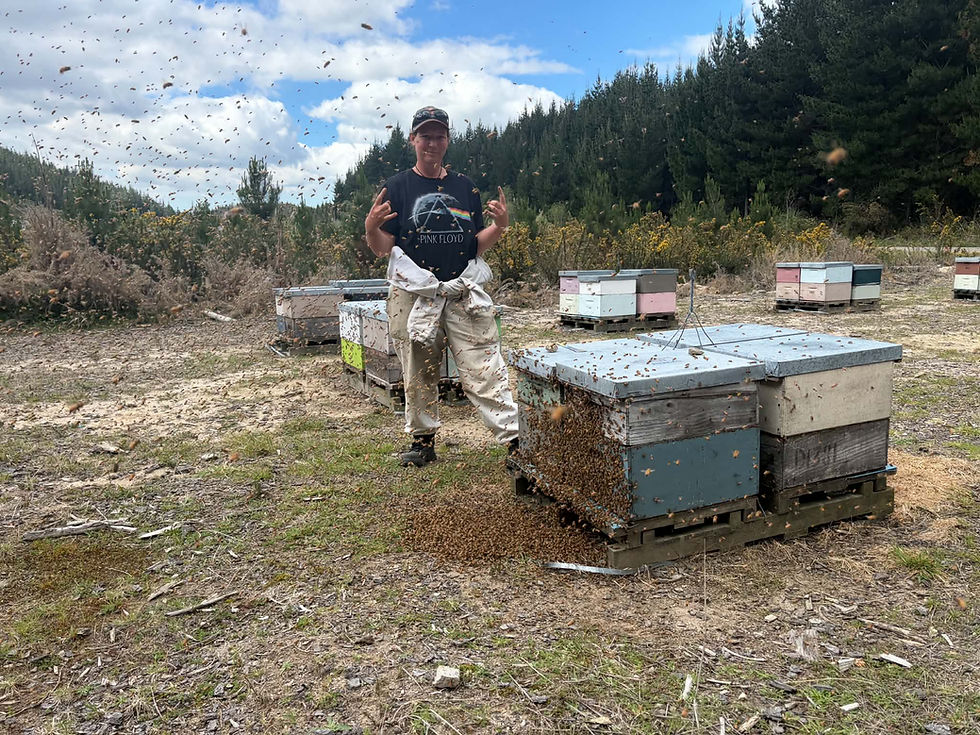
In the field, I have been through almost every hive. With only two sites to go, I can taste the end of the honey season. The bees know it too. Scrambling for a free meal, frenzied flocks of them find the truck in the first robbery of the season.

If we’re not extracting, we’re harvesting in the heat, and until now the bees have been content enough to leave us alone.

Typically, a morning’s harvest begins with me throwing my suit on over singlet and shorts. Back brace on tight, I have a new McDavid support that has literally revolutionised my life as a beekeeper. No more spasming back muscles on the ride home, my job has become more enjoyable.
While everyone else gets organised, I am the first to greet the hives. The bees are calm and aware of my presence while I code and number each box with my red crayon. Being able to identify honey boxes becomes important if AFB is found, for they are already stacked on the truck by the time I get into the brood nest.
Following me, our helper smokes up the hives and weeds all the entrances. Our third crewman cracks lids and swaps them out for the fume boards, while getting the blower and stand set-up.

Within minutes we are underway. The blower man sets the pace, lowering honey boxes to the stand in front of the hive, then blasting them with the blower. Skilfully rifling through frames with a hive tool, taking care not to bruise and tear at the honey, while making sure 99% of the bees are forcefully vacated. A good job on the blower will mean a lot less bees being brought back to the shed. This job has the added responsibility of sorting any brood out of the lower honey boxes, which we collect and place back over a hive with a queen excluder.

Once the box is pretty well bee-free, the stacker loads it onto the truck with a well-fitting cover, then comes back for more. After the honey supers are removed, my role as disease inspector begins.
This is a multi-faceted job, and many details of the hive are evident, but really, I only have one focus – finding AFB. I am confident in my ability to detect the disease, and I go into every hive like I expect to find it.
I work a hive in the usual manner, starting in the top box, by removing an outside or second frame and creating a working gap. From there I work my way across the brood box. Any frame with brood is wiggled to dislodge most of the bees and brought to the light for me to cast my eyes over both sides. It is replaced into the box, and I move to the next frame. When I have checked the brood in the top box, I install mite control, then venture into the bottom box and repeat as necessary.
I am checking the majority of the brood in the hive for discoloured, sunken or perforated cell cappings, and open cells containing slumped, discoloured and diseased larvae.

This season I have identified one hive with the fatal bacterial disease. One open cell, slumped coffee-coloured prepupal larva with collapsed segmentation. The presentation alone said it all, and it roped like Caramelo. Without witnessing the process, my brother told me to find another cell, which I could not, but I know my job, and I’ve learned to stand my ground. “I’ll bet my hive tool that’s AFB” I told him.
After I got everyone to clean and scorch their hive tools, and wash their hands, smokers and the blower stand with methylated spirits and water, the doubt on my diagnoses still remained.
Now, my brother is a top beekeeper. He’s been in the veil pretty much since I started school. He’s only been beekeeping with me a few months though as he had a year or two off doing other things.
But he’s bigger, older and more experienced. To counter his unsurety and to prove my worth, I took the frame with the suspicious larva home in a plastic bag, as we had an instant test kit in the honey shed. Turns out we didn’t need it, and I didn’t lose my hive tool in an offhand bet. Under powerful lights we were able to identify one other slightly more decomposed AFB larva, with everyone witness to the categorical ropiness.

How’s that for beekeeping brother? He hadn’t realised how passionate I am about AFB. I take my job seriously. Like a sleuthhound, if it’s there, I will hunt it out.
On a typical day though, I don’t find AFB. I might see chalkbrood, sac brood, a queenless hive or drone layer, but I am also not seeing mites, or any evidence of them in our colonies. I probably say this every issue, but for us to bounce back after a soul-destroying whack like last year, I want everybody to know there is light at the end of the tunnel.

Our numbers are building up again. We had amazing hatching success from cells in all our autumn splits, 100% – and the ones we have peeked in on are well mated and laying up hard. Requeening is also underway and we are trialling some pretty blue dotted gals from sunny Marlborough’s own Pyramid Apiaries.

Things are going really well. The bees are looking fantastic. In fact, they are remarkable. I love my job. What an immense honour it is to be a beekeeper. Embrace it.
Aimz
Aimz is a second-generation commercial beekeeper in the Bay of Plenty who took up the hive-tool fulltime at the end of the 2024 honey season. Formerly a stay-at-home mum to four kids, she has now found her footing in the family business.

Comments