
Takeaways from Mānuka Orchard Open Day 2026

It’s become a staple on the honey industry’s calendar and in 2026 Mānuka Orchard’s annual Open Day on July 24 was bigger than ever, with nearly 200 attendees filing into the Paengaroa Community Hall where a range of speakers and trade displays greeted them. Concluding with the unveiling of the honey facility’s aspirational ‘Project 2030’, there was plenty of expertise imparted. Here’s our key takeaways from the event.
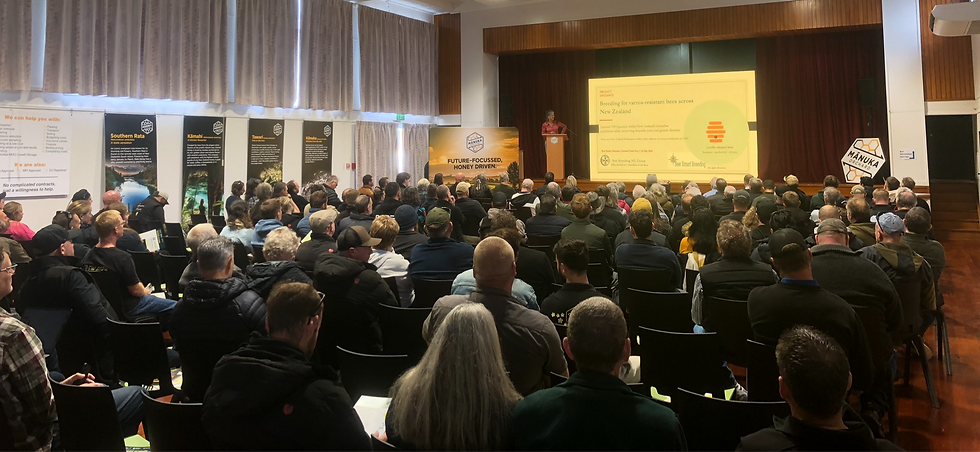
Banding together – As elections for the inaugural board of new industry group Honey and Bees New Zealand were hours from closing, Northland beekeeper Liam Gavin encouraged beekeepers to join the fledgling organisation – “get behind it, we have all been asking for it for years” – while Mānuka Orchard owner Logan Bowyer, speaking from the perspective of not a beekeeper but one who was soon to unveil his business’s attempt at a form of collective data sharing through ‘Project 2030’, added “you will be amazed at what happens when you have a united voice”.
Less left to sell – Bowyer detailed Mānuka Orchard’s “left to sell” percentage of honey as of June in each of the past five years. Around 50% of the facility’s honey was left to sell in winter 2023 and 2024, this had fallen to 35% by last winter and is now at 20%. Speaking of the industry’s position as a whole Bowyer declared, “we are trending in the direction of running out of stock and my personal position is we are at risk of closing markets”.

Blending bread and butter – Bowyer called honey blending Mānuka Orchard’s “bread and butter”, saying they blend between 20 and 30 tonnes of honey most weeks. “If you are not doing it, you are leaving money on the table” he told beekeepers.

Sharing the VSH – Mid Canterbury beekeeper Rae Butler, in the midst of a national tour of workshops imparting knowledge of breeding for varroa resistance, implored beekeepers to prioritise increasing the varroa sensitive hygiene capabilities of their bees. “It’s a waste of time if only a couple of beekeepers in New Zealand are breeding for resistance,” she says, pointing to the diminished resistant ability of the drone population. “If my neighbours are not doing it, it’s a waste of time.”
Col-Loss Pike on the way out – After 11 years at the helm of the New Zealand apiculture industry’s annual Colony Loss Survey, Pike Stahlmann-Brown announced MPI had decided to take the task in-house, leaving him out of the job. He was diplomatic about the move, but thanked beekeepers for their world-leading survey response rates over the years. “This has been a big part of my life,” he concluded, while Bowyer added “it’s hard to imagine there is anyone in the country better suited to fill this job than Pike”.

Recapping the numbers one last time – Diving into the numbers from the 2025 Col-Loss NZ survey Stahlmann-Brown clearly presented data on varroa control methods, summarising “Commercial beekeepers are using amitraz at much higher numbers than hobbyists, commercial beekeepers are using oxalic acid at much higher numbers than hobbyist and commercial beekeepers are using flumethrin in lower numbers than hobbyists.”

Thankless Wasp Control – Col-Loss results tell us 49% of beekeepers controlled wasps in 2025 and estimates that 12,200 wasp nests were eliminated thanks to those efforts – “Good on you to the beekeepers, it goes largely unrecognised,” Stahlmann-Brown added.
Imbalanced diet – The research of pollination biologist Melissa Broussard is always of interest to the audience in the heart of kiwifruit country and recent analyses of the nutritional value of a variety of kiwifruit pollen was telling. While there were differences between red, gold and green, overall “kiwifruit pollen by itself is not adequate” and access to the wider environment is important the expert stressed. “Feeding of nutritional supplements should be considered,” Broussard said, adding that high fat pollen is needed to balance honey bee diets.

MPI alliance still in talking phase – MPI regional advisor for Bay of Plenty Denis Collins wasn’t giving much away regarding the government’s proposed “Honey and Bee Alliance” which would bring various industry groups together around the same table, saying just “There is a lot of talking going on from an MPI perspective. We are very keen to see something happen.”
Insurance and mop ups – Also wearing the MPI badge was Sharon Morrell who has spent time on the front-line of the yellow-legged hornet response in Auckland. Having not seen a hornet nest since April 2 is encouraging because that date is earlier than the experts thought the pest would shut down for winter. She called the current deployment of fipronil poison, Vespex, “an insurance policy” to “mop up anything left over and, also as a bonus, lower the wasp population”.
Review and … repeat? – Morrell said the hornet response is undergoing a review of the spring and summer efforts and, if more hornets are found “the same pattern will occur, with some tweaks” once the weather warms.
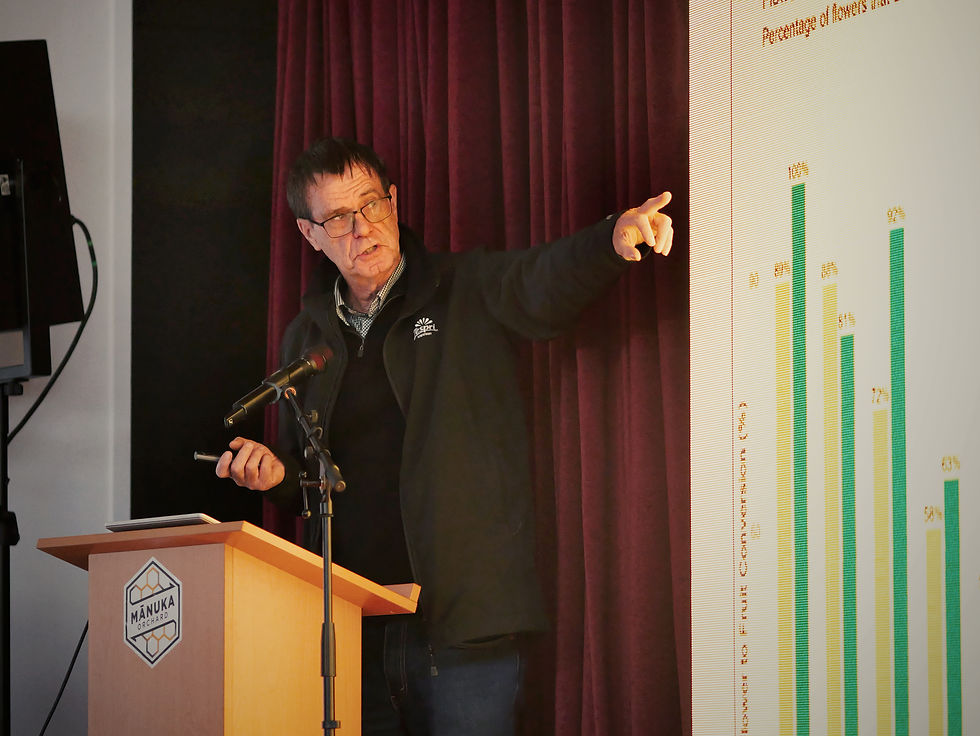
Leaving some behind – In his last month working for Zespri, long-time connection to the beekeeping industry Shane Max detailed a study of 15 green, Hayward, kiwifruit orchards between Edgecomb and Katikati post-pollination last season which revealed only around half the flowers were fully pollinated in some orchards. Max called the results “quite significant” and “a concerning worry” for the kiwifruit industry. “I think the worry is hive quality, especially in reused hives.”
Here comes the sun – Max affirmed what many beekeepers in the audience likely knew – providing gaps (either sizeable holes or whole strips removed) in hale netting above hives, along with access to direct sunlight, is critical to maximising hives’ performance as pollinators.


Honey Research Unit – “Spread the word about the Honey Research Unit,” implored University of Waikato honey researcher Megan Grainger of the institution’s new lab, having detailed their research into diastase levels in, and phenolic profile of, mānuka honey, topics which could assist market entry and marketability. “If you have a problem with honey, we want you to come to us so we can solve it,” Grainger said of her team of honey gurus.
Know your role – Following Grainger’s presentation, Bowyer offered a succinct summary: “Marketing’s job is to squeeze whatever story we can out of our honey; Megan’s job is to find that story; and our job is to make sure we don’t negatively affect that honey along the way”.
Speed you roll – One long-time beekeeper who has been largely absent from industry-wide events in recent years, but has previously served in industry governance, was heard privately praising the positivity emanating from the Open Day, even going so far as to say the mood of the industry at the event had “reinvigorated” them.


Comments