
Talking Points from Kiwifruit Country

Updated: May 5
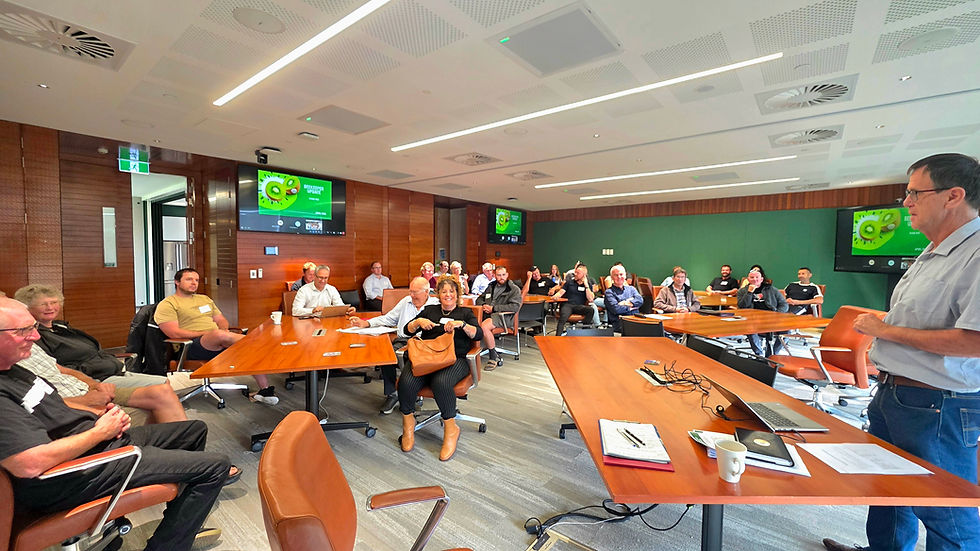
Gaining best value for pollination hives; thermal auditing of beehives; effective industry advocacy; and even that damn hornet – the Bay of Plenty Commercial Beekeepers group met on April 17 at the Mount Manganui offices of Zespri where, stimulated by attendance from various interested parties, a wide range of topics relevant to beekeeping and kiwifruit pollination were explored.
By Dave Black
A group of about 40 beekeepers was welcomed by Shane Max, Zespri’s technical consultant, who is responsible for improving the productivity of the fruit cultivation, for which pollination plays an essential part.
This year Zespri is on track to ship 220,000,000 trays (TE’s, tray equivalents, more than 7 billion fruit). The plan is to release licence for approximately 400ha of Gold3 variety annually through to 2029/30. One hundred hectares of a new red variety, Red80, is being released this season and a decision on the release of new green variety, or even varieties, is expected in the next couple of years. All up, Max estimates the continuing growth will mean there will be demand for approximately 3-4000 more hives annually through until 2030. That’s an opportunity: 14,000 more hives by 2030.

Industry Advocacy in Practice
Colin Bond, the CEO of New Zealand Kiwifruit Growers Incorporated (NZKGI), described the history of the organisation and the partnership role it plays in the regulatory framework governing the kiwifruit industry. The grower representative body, funded by growers, is committed to advocating for the business interests of its members, negotiating, advising, and managing conflicts with things as diverse as the Resource Management Act, the Recognised Seasonal Employer (RSE) Scheme, Māori Land Court administration, post-harvest operations, agrichemicals and biosecurity. The relationship ‘management’ is complicated by the reality that roughly 70% of orchards are owned by relatively “passive” growers who sub-contract to management companies, but who still need their interests protected. Fruit quality, or a potential shortfall in pollination units, are definitely things NZKGI is interested in.
Matt Dyck has worked with Kiwifruit Vine Health (KVH) since 2013 and is their biosecurity manager. KVH is also grower funded, using a levy required by an Order made under the 1993 Biosecurity Act, the Biosecurity (Readiness and Response—Kiwifruit Levy) Order 2015. KVH operates the ‘Government Industry Agreement’ (GIA) deed for the kiwifruit industry with the government and has several ‘Orders’ in place to be ready for and respond to particular biosecurity threats. Besides some, more obscure, fungal and bacterial pathogens the more familiar ones will be well known by beekeepers here; fruit flies, the Brown Marmorated Stink Bug and of course kiwifruit’s Pseudomonas syringae pv. Actinidiae (PSA).

Hornet Highways
While not the subject of an Order, KVH has taken an active interest in Auckland’s yellow-legged hornet response too. The hornet will affect all pollinators, not just honey bees, yet there is no Order because there is no relevant GIA and no levy.
During questions it emerged Arataki Honey owner Russell Berry was working with the logistics company Mainfreight to establish hornet monitoring at their depots. UK experience suggests that long-distance dispersal of the hornet can often be along highways in vehicles, like trucks.
In a related train of thought, some beekeepers wondered whether the KVH PSA ‘rules’ and risk regarding the transit and 10-day stand-down for beehives moving between orchards in the North and South islands was properly considered.
Heat Check
Pollination hive auditing has generated a bit of interest again in recent years, for a variety of reasons. Discussed at a previous meeting, in 2025, Zespri, along with research partner StartAFresh and assisted by beekeepers Richard and Michael Klaus, plus Neale Cameron, presented a report of an investigation and recommendations for the use of thermal imaging cameras for determining hive strength. Further work is required before these devices can be deployed for this purpose, although this initial exploration suggested they would detect poor quality hives if they were properly calibrated and used appropriately. The prospect of using cameras for rapid, non-invasive auditing remains, just not yet.

It’s also not clear how they would ‘fit in’ to the pollination unit delivery process. The question of who would use them, when, and how will the data be treated, remains.
The meeting heard, from several participants, how growers are understandably keen to see hive auditing, of any kind, applied widely and reliably, but good auditing actually protects both parties to the service. If the quality of hives being supplied remains unknown the supplier can be accused of not providing value for money, even of fraud, they could lose the chance of repeat business, and are easily ‘undercut’ by a competitor. Beekeepers and growers, when they stop to think about it, realise a ‘race to the bottom’ isn’t a sustainable advantage to either of them.
AsureQuality’s Tony Roper explained that he has trained beekeepers in hive auditing for many years (even me, 16 years ago), and last year he held a training session locally assisted by Byron Taylor and Richard Klaus, but at quite short notice it didn’t really attract the right audience. The industry’s ability to train properly independent and skilled auditors in either island is nowhere near adequate. It sounds like beekeepers are concerned enough to try and do something about it.

Call the Doctor
Dr Melissa Brousard, a well-known crop pollination scientist with Plant and Food Research, (now a division of the Bioeconomy Science Institute) was on-hand over a video link to present and discuss some yet-to-be-published research. This had been jointly commissioned and funded by Zespri and her employer’s plant variety rights earnings, to examine the nutritive value of pollen from the current varieties of kiwifruit.

It’s been some time since the dietary adequacy of kiwifruit pollen was looked at; a 1992 paper explored male and female-produced pollen from green Matua and Hayward varieties of Actinidia deliciosa[i], but this has little relevance for bees in today’s gold, red or kiwiberry orchards.
It’s not just about nutrition. The different value of the pollens, or the different properties, may determine how individual bees choose to forage and how the colony ‘chooses’ to allocate its foraging workforce.[ii] We have also learnt that the ratio of proteins to lipids in the diet matters; that larva appear to stop feeding if the ratio is ‘wrong’ (if they have enough of one they don’t continue feeding to get enough of the other!), and that certain plant-derived sterols (a class of lipid) are essential to honey bees. Pollination and nutrition are inseparable and discussion turned to how we should give more thought to mowing swards, planting complimentary plant forage, and supplements.
Final Thoughts

If all that wasn’t enough, Beequip wrapped-up with their current advice on the various presentations of oxalic acid for treating varroa. While data from the annual Colony Loss Survey shows beekeepers use a variety of treatments throughout the year, oxalic acid now seems to form the backbone of the successful control methods used in operations here.
I’m sure the BOP Commercial Beekeepers would want me to acknowledge and thank Zespri and the other contributors to the meeting for organising and participating in a lively and informative afternoon. It was only unfortunate that a dozen or so of our beekeepers were missing as several roading issues intervened.
The next few months look to be quite busy after all.
References
[i]Clark, C.J., Lintas, C., 1992. Chemical composition of pollen from kiwifruit vines. New Zealand Journal of Crop and Horticultural Science 20, 337–344. https://doi.org/10.1080/01140671.1992.10421776
[ii]Vaudo, A.D., Tooker, J.F., Patch, H.M., Biddinger, D.J., Coccia, M., Crone, M.K., Fiely, M., Francis, J.S., Hines, H.M., Hodges, M., Jackson, S.W., Michez, D., Mu, J., Russo, L., Safari, M., Treanore, E.D., Vanderplanck, M., Yip, E., Leonard, A.S., Grozinger, C.M., 2020. Pollen Protein: Lipid Macronutrient Ratios May Guide Broad Patterns of Bee Species Floral Preferences. Insects 11, 132. https://doi.org/10.3390/insects11020132



Comments