
The Great Secret of Where ‘New Zealand’ Propolis is Sourced
Updated: May 4
By Eloise Martyn and Patrick Dawkins
For many New Zealand beekeepers propolis has long sat in the background as an easy add-on, a modest earner, something that can be collected with relatively little extra effort. But in recent years, it has also become a source of frustration, as global supply chains and shifting demand reshape the market in ways that don’t always favour local producers.
Despite New Zealand’s reputation for high-quality bee products, and the consistency of its propolis, much of the value at scale is increasingly disconnected from local supply. The country’s largest apiculture brand, Comvita, is understood to rely on imported propolis rather than sourcing from New Zealand beekeepers – raising questions within the industry about why a product that can be produced domestically is being brought offshore. Those are questions both Comvita and fellow propolis giant Mānuka Health are not willing to answer though, having shunned requests from Apiarist’s Advocate to shed light on their propolis buying and selling practices.
A Beekeeper’s Perspective
Few people have seen the evolution of the New Zealand apiculture industry as closely as Russell Berry of Arataki Honey. A beekeeper since the age of eight, working alongside his apiarist father, Berry has spent a lifetime in the sector. Today, he continues to work closely with more than a hundred beekeepers and has been deeply involved in both the production and processing side of propolis. In recent years Berry’s Arataki Honey has been the most active buyer of raw propolis from beekeepers.
“At Arataki Honey, we have a processing plant for propolis where we clean the mats. We do trips around the North Island and trips around the South Island and collect the mats, clean them, and then deliver the mats back again.” Berry explains.
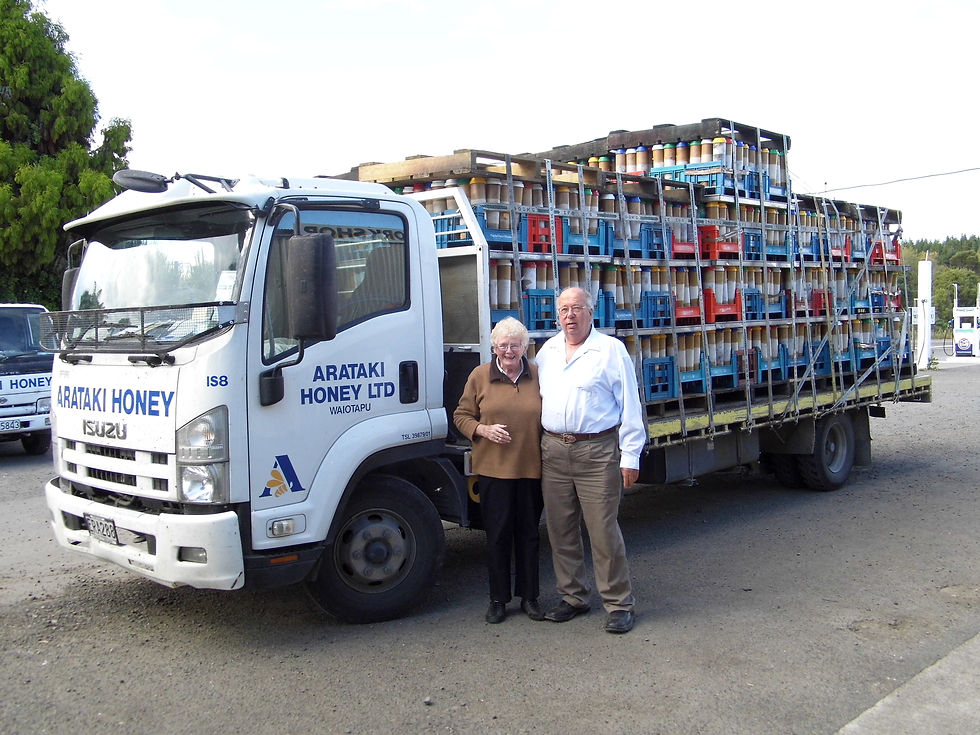

“To process the propolis, we have a geothermal steam bore, which helps keep our costs down. Our products in New Zealand, including propolis, are considered better than anywhere else in the world.”
Berry says almost all of their propolis stays close to home.
“Most of our propolis is sold to outlets in New Zealand who sell it both domestically and abroad. We do export a small volume of our own propolis”
However, he points to a shift in the market that has made it harder for local producers to compete.
“The problem was, one or two larger companies started importing cheaper propolis, and we couldn't compete on price.
“We slowed down the purchasing of propolis around three years ago. We had three shipping containers chock-a-block. We invested in buying propolis back then and hoped it would help the beekeeper carry on beekeeping.”
Despite this, processing volumes remain strong.
“Annually, we pack an awful lot of bottles of propolis. Sometimes I ask my son Mark, ‘how much did you bottle today?’ And some days they've bottled 7,000 units.”

Berry’s connection to beekeeping spans generations. He began helping his beekeeping father at just eight years old, and by around 12 was already driving beekeeping trucks. At 18, he helped his father build the Waiotapu facilities that would become the foundation of the business seen today at Arataki Honey’s Rotorua plant. Diversification – including propolis production and processing – he says, has been key to survival.
“We have developed a lot of sidelines, which has saved us. We were very fortunate not to have invested only in mānuka, but instead invested in other things, such as sending bees to Canada, propolis, pollen, and pollination for kiwifruit.” Berry explains.
“There are seven million bees in an airline pallet, and last year we exported 77 million bees to the Canada market.”

Today, Arataki’s Rotorua division employs 60 staff and works with more than a hundred beekeepers, with propolis continuing to play an important role in the business.
Berry estimates that of all of the commercial beekeepers nationwide, around half of them are making some income off propolis and that, while it is not a huge money earner, it is still an earner. He says it's not much work to put a mat on a hive, and it is income that beekeepers can be making.

He also notes that “propolis varies a lot in different areas. For example, on the West Coast in the South Island, there's very little propolis as it's all native trees.”
The Wider Concern
Berry draws a broader comparison with other parts of New Zealand’s primary sector, seeing clear parallels with what is now happening in the propolis market as imported product undercuts New Zealand supply – it’s the part of free trade that he doesn't like at all.

“We've got a problem here in New Zealand. We have peas that growers can grow well, but then someone comes and imports peas. It’s the same with peaches, we're ripping peaches out. We're losing our ability to look after ourselves if something goes wrong.”
Market Dynamics and Demand
Chris McNaull, marketing manager and director at Arataki Honey Ltd’s Rotorua Division, says the fundamentals of propolis remain strong, even if the market has softened.
“Unlike honey, propolis can be imported into New Zealand.” McNaull says.

“Imported propolis has always been present in the market, but as demand has weakened its availability has become more noticeable and has added additional competition for New Zealand beekeepers and producers. At Arataki we choose to work solely with New Zealand origin propolis. One of the advantages of New Zealand propolis is the consistency. In some countries, China and Brazil, flavonoid levels can vary significantly depending on the region and plant sources, whereas New Zealand propolis tends to be far more consistent.”
Demand has shifted significantly in recent years.
“Demand was strong prior to Covid, surged during the pandemic, and has since eased back considerably. At present we are sitting below what we would consider normal demand levels,” McNaull says.

Consumer use remains, particularly in health-focused products.
“Most consumers are using propolis for immune support and oral health. We are seeing good demand in lower strength formats like tinctures and extracts, as well as value-added products such as sprays and lozenges where consumers are looking for a balance between efficacy, convenience and price.”
However, challenges persist, with McNaull elaborating, “regulatory and contamination requirements remain one of the biggest challenges in the propolis sector and compliance expectations continue to tighten across multiple markets”.

Global Supply and Shifting Balance
Globally, propolis is a well-developed industry in several countries, such as Brazil, which is one of the world’s largest producers. In the major market of Japan, propolis products are widely available across a range of price points, reflecting strong consumer demand.
Against this backdrop, questions remain about sourcing decisions by major New Zealand brands. Propolis is Comvita’s stated second priority after mānuka honey, yet its historical investment in Uruguay-based supplier Apiter – and subsequent write-down – highlights the complexity of global supply chains.

Comvita’s propolis range includes capsules and sprays and, while New Zealand based research is touted in helping create the products, the ingredients list does not include source country. The Comvita website states ‘we source our raw propolis from Comvita beekeepers and trusted beekeeping partners’.
Further specifics of Comvita’s propolis sourcing remains unclear as the country’s largest exporter of beehive products has been unwilling to answer Apiarist’s Advocate’s questions on the matter. However, the Apiter investment in 2018 coincided with a slowdown in buying on the New Zealand market. At the time Apiter chief operating officer Laura Roth called their business “the major (propolis) producer in South America”.

Back then Comvita CEO Scott Coulter was not hiding the fact that South American propolis made a worthy substitute to that which could be produced in New Zealand and bought from Kiwi beekeepers.
“Uruguayan propolis has the high levels of phenolics and flavonoids which match the profile of New Zealand propolis,” Coulter said in a statement to the NZX – the country’s stock exchange where companies make official public disclosures.

“Certain plants produce higher levels of these protective compounds when exposed to climatic conditions that are from a similar latitude to New Zealand. Not only does our investment in Apiter secure our supply base it also provides access to the leading intellectual property around propolis extraction, value-added wound care, and potentially pharmaceutical and nutraceutical products derived from propolis."
Mānuka Health was also once a prominent buyer of New Zealand beekeepers’ propolis, but that has seemingly slowed, or come to a complete halt. Like Comvita, they have not responded to request for comment. Their products retailed online state ‘New Zealand Propolis’ as a core ingredient though.
Propolis New Zealand, based in the Nelson region and still a registered company, has also slowed their buying behaviour in recent years. Their website is down and they also have not responded to a request for comment.
The Future of Supply
As the propolis market continues to evolve, the question remains whether New Zealand’s biggest brands will further integrate local supply into their sourcing strategies, or continue to lean heavily on offshore product.
'Brand New Zealand’ continues to feature prominently in propolis marketing, yet Kiwi beekeepers appear increasingly sidelined – or, in some cases, excluded altogether.



Comments