
‘You Have Misspelled “Manuka”’
Updated: Oct 2
In our September edition, we carried a report on the Kānuka Industry Hui held in Rotorua 17-18 August, Kānuka Honey: Time to Stand on Its Own. It was “unmistakable”, the report said, that the “market opportunity” for kānuka honey and kānuka oil was “already there”. Bruce Roscoe discusses “market opportunity” for non-mānuka honey types and backgrounds the Treaty of Waitangi reports that bear on the question of naming rights for the words kānuka and mānuka.
By Bruce Roscoe
One can only marvel at the fortitude of those who strive to reach a new honey frontier beyond the mānuka-clad hills and dare to dream that prosperity may await. They have embarked upon a journey as perilous as Odysseus' from Troy to Ithaca, as narrated by Homer in his epic poem. Odysseus walked and sailed over 10 years, and it may take kānuka proponents as long to gain a toehold in any market.
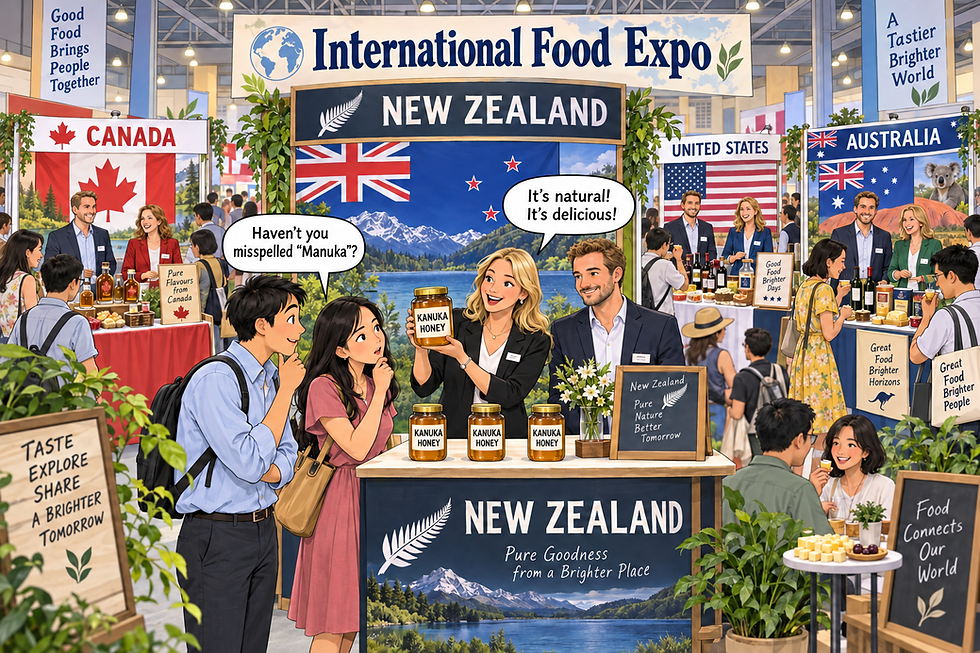
When shown a jar or kānuka honey, I heard a Tokyo trade show visitor ask, ‘Haven’t you misspelled “mānuka”?’ At a later promotion, two visitors tasted mānuka and kāmahi honeys. One chose the mānuka, the other the kāmahi. The visitor who had chosen the mānuka turned to the other visitor and said, “If you are buying New Zealand honey, you should buy mānuka. It is the real thing.” Hearing this, the visitor who had chosen the kāmahi reluctantly returned it to the table and picked up a jar of mānuka.
The trade show visitor had asked a fair question. Writing mānuka as kānuka is an easy enough typographical error to make. On a QWERTY keyboard, you lower your right hand to the bottom row of letters and position your index finger over the “m” key. But your finger settles on the key immediately above and a bee’s wing to the right. You type the letter “k” and complete “kānuka” as though nothing is amiss.

Japan is an instructive market. From the outset, mānuka honey was regarded as a quasi-stomach cancer treatment. UK research (1994) showed that mānuka honey inhibited growth of the bacteria Helicobacter pylori, which can lead to stomach cancer.1 At the time, thanks to a heavily salted seafood diet, Japan suffered one of the highest rates of stomach cancer. The research resonated in a wide spectrum of Japanese society. Although efficacy had been shown only in a laboratory and not a clinical trial, if there was even a small chance of the lifting of a death sentence, mānuka honey would win place as an alternative medicine. Which it did, and demand later extended to influenza prevention.
Japan was Comvita’s first choice for establishment of an overseas subsidiary (2002). Because of its weight in the industry, Comvita serves as a type of bellwether for workable ideas. No mention of kānuka can be found in Comvita annual reports over 23 years and in only one year are non-manuka honeys introduced (clover and rewarewa; 2015).

The Diameter of the Sky

An import permit hurdle — in effect, a ban; no New Zealand law bans the import of honey — shields local fare from foreign competition. This protection can create a view of the world that a frog in the well would hold, where the frog looks up, measures the diameter of the sky, realises that it matches the diameter of the well, and believes that what works in the well should work in the world. In this view, the world’s arms can be opened to embrace kānuka and other non-mānuka honey types.
Japan imported honey from 48 countries in CY2024. Main suppliers were the usual suspects China, Argentina, and Canada, while among exotic origins were Guatemala, Kyrgyzstan, and Lithuania. Japan’s largest upper tier supermarket chain (Seijo Ishii; 238 stores) stocks honeys from around 15 countries. It has selected about 20 New Zealand honey products — all are mānuka, in various grades, from four suppliers. (Otago white clover comb honey was stocked until around 2020 but withdrawn over glyphosate contamination fears. Hungarian comb honey has taken its place.)

The mānuka labels on the Seijo Ishii selection show MGO (methylglyoxal), UMF (Unique Manuka Factor), and dual MGO / UMF ratings. Among the offerings of the four suppliers, the lineup from a South Island packer is typical — MGO30+ (which almost certainly is multifloral mānuka but labelled only as “mānuka”), MGO83+, MGO263+, and MGO515+. (The MGO values 83, 263, and 515 are piggy-backing off UMF5+, 10+, and 15+ values.)
The Seijo Ishii thinking is, MGO and UMF are both recognised, so both are needed. Two suppliers of each rating type, and at least three grades within those types, are needed in the event that one supplier falls over or runs out of stock of a key grade. Failure to supply key grades, especially during peak mānuka season — late autumn to early spring in the northern hemisphere — is unacceptable to the point of relationship fracture.
In what is essentially a real estate business where products are expected to pay rent in the form of margin on turnover for the shelf space they occupy, slow- or non-payers are soon evicted. Before they risk placing a slow-moving non-mānuka honey, purchasing managers will explore mānuka options such as organically certified product, or derivative products such as lozenges or nasal sprays, or explore further the range of antibacterial honeys and add, as often seen, Australian jarrah honey.

Kānuka will not get an audience with a retailer’s purchasing department. Even if it did, it would fail the final test of whether store staff could explain to customers the difference between mānuka and kānuka, when it is already difficult to explain mānuka label ratings. For customer service at supermarkets and food boutiques, a basic knowledge of some 5,000 products is required.
Non-mānuka honeys are sold mainly through webstores where space allows for detailed introduction and multiple graphic presentation but even then, more often than not, they are bundled with at least one other product whose name includes the word “mānuka”.
The cement of “all worlds are mānuka” has been poured and dried by the UMF Honey Association (UMFHA). Since incorporating in September 2002 (and informally for two-three years earlier), UMFHA has deployed some NZD24.3m in a global effort to champion only mānuka honey. UMFHA promotes mānuka as the “gold standard” against which “other honey and natural health foods are compared” (UMFHA website). In that sense, all non-mānuka honeys are slated as inferior.

Exclusion and Removal

In large part, kānuka is a story of exclusion and removal. Along with mānuka, it belonged to the Leptospermum genus, as Leptospermum ericoides, until 1983, when it was reclassified into the Kunzea genus. Since then, the genus has been split into 10 varieties endemic to New Zealand. Of those 10, seven were announced as new in 2014 research.2
Australia has some 80 species of Leptospermum and maintains it can call honey from the nectar of any of them “manuka”, while New Zealand has countered that authentic mānuka honey can be produced only from New Zealand-sourced Leptospermum scoparium.
Here’s the rub. The kānuka lobby appears to believe that honey produced from the nectar of any of the 10 Kunzea species — whether robusta from the North and South Island, tenuicaulis from only the North Island, or ericoides from only the South Island — can be called “kānuka”. (Australia has some 50 species of kunzea tree.)

Kānuka honey was excluded from the governmental New Zealand Story honey video project in 2020, which limited its selection to kāmahi, mānuka, clover, and multifloral honeys. Titled “New Zealand Honey Story”, the script did not venture much beyond “…there’s such an amazing variety of beautiful flavours”.

The Ministry for Primary Industries’ (MPI) 2018 scientific definitions for mānuka honey took aim at kānuka as an impostor. As a result, the number of New Zealand Customs export codes for honey was expanded from 8 to 17 in a largely binary system where honeys were or were not mānuka in the categories of bulk and retail pack and monofloral and multifloral and “other”.
Nine codes now include the word “mānuka” and 8 (comb, honeydew, and various “other”) do not. Because neither MPI definition nor export code exists for kānuka honey, export certificates for that honey type will state only “HONEY”. As a result, no kānuka data for any market can be collated.
Mānuka honey across all codes accounted for 89.5% of the 11,433.4 tonnes of honey New Zealand exported in CY2025 and 93.1% of the NZD448.9m value.
Though the MPI scientific definition for monofloral mānuka honey may outwardly appear to exclude kānuka honey, botanical science and the dark arts of honey blending suggest a more complex world. Comvita, in its 53-page, June 2017 submission to MPI argued that the definition failed in its intent to authenticate mānuka honey. Kānuka lay at the heart of the argument.3 The chemical marker 3-phenyllactic acid (3-PLA), one of the four markers in MPI’s monofloral definition, was found in both kānuka and mānuka, and regional variation could determine inclusion or exclusion as mānuka. (Northland mānuka honey producers in particular believe that they are unscientifically penalised by the definitions.) Comvita believes that a large volume of kānuka can be sold as mānuka and, ironically, has found that some honey labelled as kānuka meets the monofloral mānuka definition.
At a time when news media at home and abroad were screaming “fake mānuka”, MPI only reluctantly stepped in to regulate. For years, half the industry had believed that kānuka should not be sold as mānuka, and the other half believed that it could. The industry, left to itself, could never agree on a definition of this honey type. The picture that emerges nearly a decade after the enforcement of the definitions is one where major honey packers do not need to promote kānuka honey, because they may already be making profitable use of it. And offshore mānuka brands, unencumbered by official scientific definitions, particularly in Australia and UK, can be expected to welcome kānuka in bulk at bush honey prices.

The Taonga Tautology
The report on the Rotorua hui stated: “Kānuka is regarded as a taonga species by Māori”. Which is tautological, considering that absolute Māori rights of ownership and control (te tino rangatiratanga) are asserted for all native flora and fauna species in the WAI 262 claim of October 1991. (WAI claims refer to claims made under the Treaty of Waitangi through the Waitangi Tribunal.)4
This claim mentions neither kānuka nor mānuka. As specific concerns, it cites four species of flora (kumara, pohutukawa, koromiko, the climbing plant puawananga) and three species of fauna (the flax snail pupu harakeke, tuatara, and the wood pigeon kereru) and adds “indigenous export timbers, various species”. The word ‘taonga’ (valued possession) occurs in the 28-page claim only in relation to the flax snail and native timbers.

The WAI 262 report that answered the 1991 claim was issued July 2011. Over 298 pages, it found no space to mention ‘kānuka’. Impressed that, “Today mānuka oil and mānuka honey are the basis for a multi-million-dollar industry…”, it sketched research and industry developments in 33 mānuka references and, across multiple fields, sent ‘taonga’ into overdrive (626 mentions).
Mānuka Charitable Trust (MCT; February 2020) is born of the WAI 262 claim and response, as is Kānuka Charitable Trust (KCT; March 2023). KCT is addressed to indigenous rights law firm, Kāhui Legal (Wellington), which oversees the mānuka honey certification trademark cases pursued by MCT.
Let the Do-i Begin
If the “market is already there”, let a do-i follow the hu-i held by the kānuka lobby. Design labels, order in jars, warm the honey in the drums, stir and pour and pack and chill the honey, draw up presentation materials that anchor to an authoritatively and persuasively presented website, and seize the market that is already there.
Bruce Roscoe is a Japan-resident researcher and former foreign correspondent and securities analyst who has worked as a honey import and distribution consultant in Japan since 2012.
References
1. "Susceptibility of Helicobacter pylori to the antibacterial activity of manuka honey." Journal of the Royal Society of Medicine, 1994 Jan; 87:644. https://journals.sagepub.com/doi/10.1177/014107689408700106
2. “A revision of the New Zealand Kunzea ericoides (Myrtaceae) complex.” PhytoKeys 2014 Aug; 40: 1-185.
3. MPI has virtually hidden the June 2017 Comvita submission by bundling it with other submissions and has heavily redacted it. The bundle can be downloaded from this MPI link. The Comvita submission can be found on pages 130-183 of the PDF. Bookmarks (type Ctrl + B) reveal key content underlying the redactions. https://www.mpi.govt.nz/dmsdocument/20387/direct
(4) The WAI 262 claim of 1991 can be downloaded from the Wai 262 website and the WAI 262 report of 2011 from the Waitangi Tribunal website.


Comments