
Hornet Response Continues on North Shore Only

Updated: Mar 9
Beekeepers are wary and Biosecurity New Zealand (BNZ) has been out in force in certain Auckland suburbs over the past four months as a yellow-legged hornet incursion response has been implemented. So far hornets have been found in Auckland only and, on February 4, BNZ presented a webinar to approximately 160 beekeepers to detail the response thus far, from nest removal and radio tracking technology, to what beekeepers can do to help as summer winds into autumn.
Nests of the hornet, which can devastate honey bee colonies and prior to June 2025 had never been sighted in New Zealand, continue to be found on Auckland’s North Shore. As at March 2 81 nests had been located and destroyed in three, over-lapping, surveillance zones extending out 11km from ‘hot spots’.

Has the hornet moved further afield? BNZ don’t believe so, but there has been no trapping outside of Auckland conducted by the Ministry for Primary Industries department.
There is now a race to discover and destroy as many nests as possible as the pest’s natural lifecycle turns to creating many queen hornets to first mate in late summer and autumn, and then hibernate – and thus be much harder to locate – over winter.
“We believe there is much work to come, but that eradication is certainly feasible here,” BNZ say.

“We are cautiously optimistic. Given the number of nests we are finding, and the fact we are still in a confined zone we believe we have a good chance of eradication.”
Key Takeaways from February 11 Webinar
Euro Overstayer – DNA testing has confirmed that this incursion began from a single mated queen and that queen originated in Europe. BNZ is unsure how it arrived.

Why the Slow Start? – Two male yellow-legged hornets were first found in Grafton, on the south side of the Waitematā harbour, in June 2025 and BNZ wrongly assumed they “may have been solitary hitchhikers”. Their incursion response did not begin until four months later once nests were established – “as the only hornets of importance would be over-wintering queens for which there are no viable means of detection”.

Why Were Those Males So Far from Home? “The confirmed specimen and suspected male were some distance away from the current central focus of operations in Glenfield and Birkdale. Given that the genetic data indicates that these are related to the rest of the hornets, it is likely these males were offspring of the initial founding queen (siblings of the queens we are finding this season) and were at the edge of their range searching for mates at the end of last season. This is a known behaviour for male yellow-legged hornets. The areas they were found in are covered by our current trapping network and no further activity has been detected in those areas,” BNZ say.
In Zone – The North Shore surveillance zone features more than 1000 hornet traps, and has 575 registered apiaries. Around 50-60 staff and contractors are on the ground in the area on any given day, supported by approximately 80 staff “coordinating and supporting operations”.
On the Look-Out – BNZ has “surveyed” 8334 properties looking for the pest and on average receives 110 notifications each day, totalling more than 11,000 since the response began. Within 1km of hornet finds there are 387 traps which are checked every two days, from 1-5km there exists 443 traps checked twice weekly, 5-11km there are 268 traps checked fortnightly.
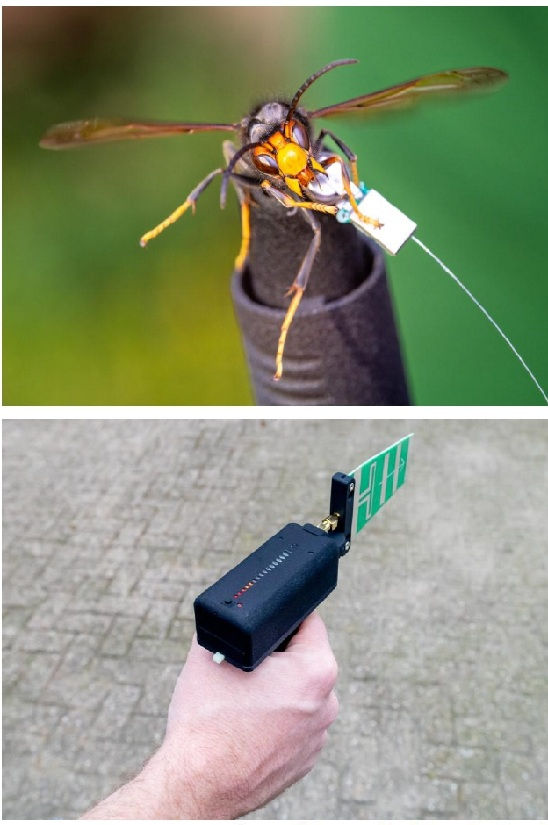
Going Gaga for Radio – Radio trackers are now “a core tool” for locating nests and once a field hornet is tagged the nest is usually located “within a few hours”. Fourteen nests have been found using the technique, which is particularly useful for finding the hornet’s secondary nests high in trees, which they relocate to in the latter half of summer.

Signing Up – Digital billboards and signs alerting the public to the hornet’s presence and asking them to report sightings have been erected on the North Shore. Online and print advertising has also been used.
What Can Beekeepers Do? – Through summer and autumn beekeepers are advised to observe hives for signs of ‘hawking’ – that is hornets preying on flying bees at hive entrances – and put out traps and monitor them. Hawking and defensive bee behaviour should be photographed and BNZ notified.
If a Nest is Found – Do not disturb it or get too close. Take photos with a scale item to help prove size, then notify BNZ. Utilise the yellow-legged hornet response website.
Kiwi Calendar – Precisely when queens will begin to be produced and undertake mating flights is not known, and is dependent on “a wide variety of environmental factors”. To help determine this, nests are being dissected to understand the developmental stages of the population.

Winter Worries – Once queens are mated and hibernate for winter (usually in a warm place not far from the nest in which they emerged) the risk of “hitchhiking” will be much higher. One mated queen is all it took to get the population started in New Zealand, and one mated queen hitching a ride out of the North Shore would greatly dimmish eradication hopes. BNZ lists the following areas as likely places for hornet ‘hibernacles’: tree hollows, under bark, wood piles or leaf litter, but also man-made nooks and crannies such as those in garden equipment, camping gear or wooden packaging.

SOS to Nature? – There is no silver bullet solution in nature to control yellow-legged hornet populations – such as varroa does for honey bees. “A variety of parasites, parasitoids, viruses and entomopathogenic fungi have been observed on V. velutina, however none of them are thought to be effective biocontrol agents for a variety of reasons,” say BNZ.
Close to Home – foraging hornets usually work within 500m of their nest, but have been seen out to 2km.
Allergic Reaction – Experience from the UK, where the hornet is more established, shows that those most at risk of an anaphylactic reaction to a hornet sting are those who have allergies to common or German wasp stings, because allergic reactions are highly similar between Vespa and Vespula species. Epipens are effective on any form of anaphylactic reaction, but should not be used to treat pain alone from a sting.

Vespex Potential – The manufacturer of fipronil-laced protein bait ‘Vespex’, which is highly effective at killing common and German wasp populations during times of protein foraging, has undertaken trials in France with the fipronil removed and it has proved attractive to the hornets. Limited data, but potentially a very important tool.
Outside of Auckland – MPI does not have traps set outside of Auckland and is heavily reliant on the general public to notify them of any hornet spread. “It has been noted in other countries, that due to the sporadic and random pattern of spread by hitchhiking, the most effective way to detect these is through effective public reporting.”
Hot Spots – Thermal imaging is not seen as a practical tool for locating hornet nests, with BNZ believing tracking of hornets to be far more effective. “Once a location is known, nests can be seen using thermal imaging. However, large-scale area-wide use of thermal imaging for detecting nests has not been effective anywhere else.”
The full yellow-legged hornet response website can be found here.


Comments