
Introducing Dr Mark Goodwin, ‘the Scientific Beekeeper’, and Keeping Records
Updated: Jan 4
THE SCIENTIFIC BEEKEEPER
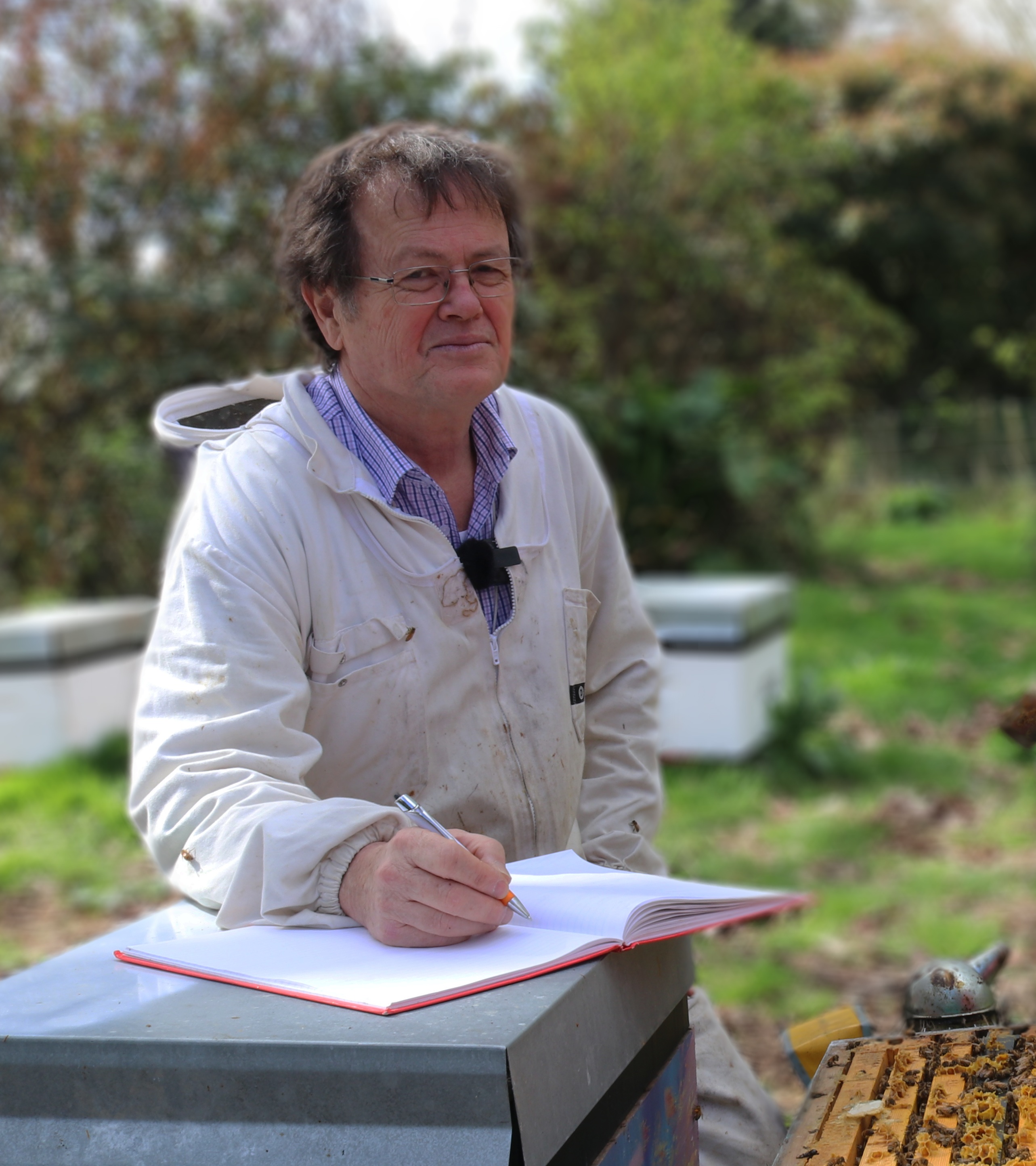
Editor’s introduction: It pleases me to introduce a new, regular column being written by Dr Mark Goodwin, where one of our most esteemed honey bee scientists can impart some of what he has learnt from his research, and from beekeepers in New Zealand and around the world.
Dr Goodwin is a honey bee scientist and pollination biologist. He set up and led the honeybee research team at Ruakura in Hamilton for 35 years. He has vast experience in beekeeping, having given lectures and worked with beekeepers and growers in 19 different countries, written 25 scientific papers, hundreds of technical articles, books on American foulbrood (AFB) and varroa, two on pollination, three on beekeeping (Control of Varroa: A Guide for New Zealand Beekeepers; Elimination of American Foulbrood Disease Without the Use of Drugs; and Best Practice Beekeeping), two on history and one book on birds. He has also produced a YouTube series on AFB and another on beekeeping.

As well as that significant body of written and audiovisual work, for his wider efforts he was awarded the inaugural Peter Molan award for excellence in apicultural science in 2016, HortResearch’s outstanding achievement award, Scientist of the Year award from the Foundation for Arable Research in 2009, a Kudos Science Trust entrepreneur award, Apimondia silver medal, and a NZ Royal Society Science and Technology medal.
All up, Dr Goodwin holds a wealth of knowledge over a wide range of topics relating to beekeeping, from disease control to pollination success, honey production to invasive species. We look forward to helping him share what he knows, and an appropriate place to start is, how beekeepers can keep record of their in-hive findings.
Keeping Records
By Mark Goodwin
All beekeepers are used to keeping records, even if it is only to please the Inland Revenue Department. Records can also be of great benefit to a beekeeping business.
All approved beekeepers must keep records of when AFB inspections are carried out, how they are conducted, who did the inspections, when the AFB Management Agency (now New Zealand Bee Health and Biosecurity) was notified of any AFB hives, and when they were destroyed.
Commercial beekeepers should keep other records for their own use. This is more important if the beekeepers have staff working for them. When keeping records it is important to consider how easily they can be accessed and how useful they will be.
The most common record that beekeepers keep is a work diary which records the work done in chronological order. Another important record is an apiary diary so that beekeepers can see what was done to the hives last time the apiary was visited and what needs to be done on the next visit.

A commercial beekeeper I was working with demonstrated what can happen if you don't keep good records. He wanted to show me a site that he was going to put hives on. Driving across the paddock he saw that somebody had beaten him to the site as there were already hives there. When we got closer, he could see that they were his own hives. They had been moved to the site two years prior and he had forgotten that he had done it. This was before varroa, so the hives were still alive. The two-box hives were solid with honey and only had small patches of brood.
Some beekeepers number all their hives, which is very useful when they need to do something to a hive when they next visit or instruct someone else to do something to a particular hive. This can be easily done by fixing sheep ear tags to the flight boards. If you only number boxes you will occasionally end up with two boxes with different numbers on the same hive. If you want to take the high-tech approach, I have seen beekeepers using barcodes to identify both hives and boxes.
It can be difficult to inspect hives fully when honey boxes are removed as it is heavy, hot work. To shake all the bees off frames to do a careful AFB check can also result in bad robbing problems. The boxes could be given the hive number with a vivid marker as they are removed, and a full AFB check could be done before the boxes are extracted. The boxes from any AFB hive could then be removed as it comes up for extraction.

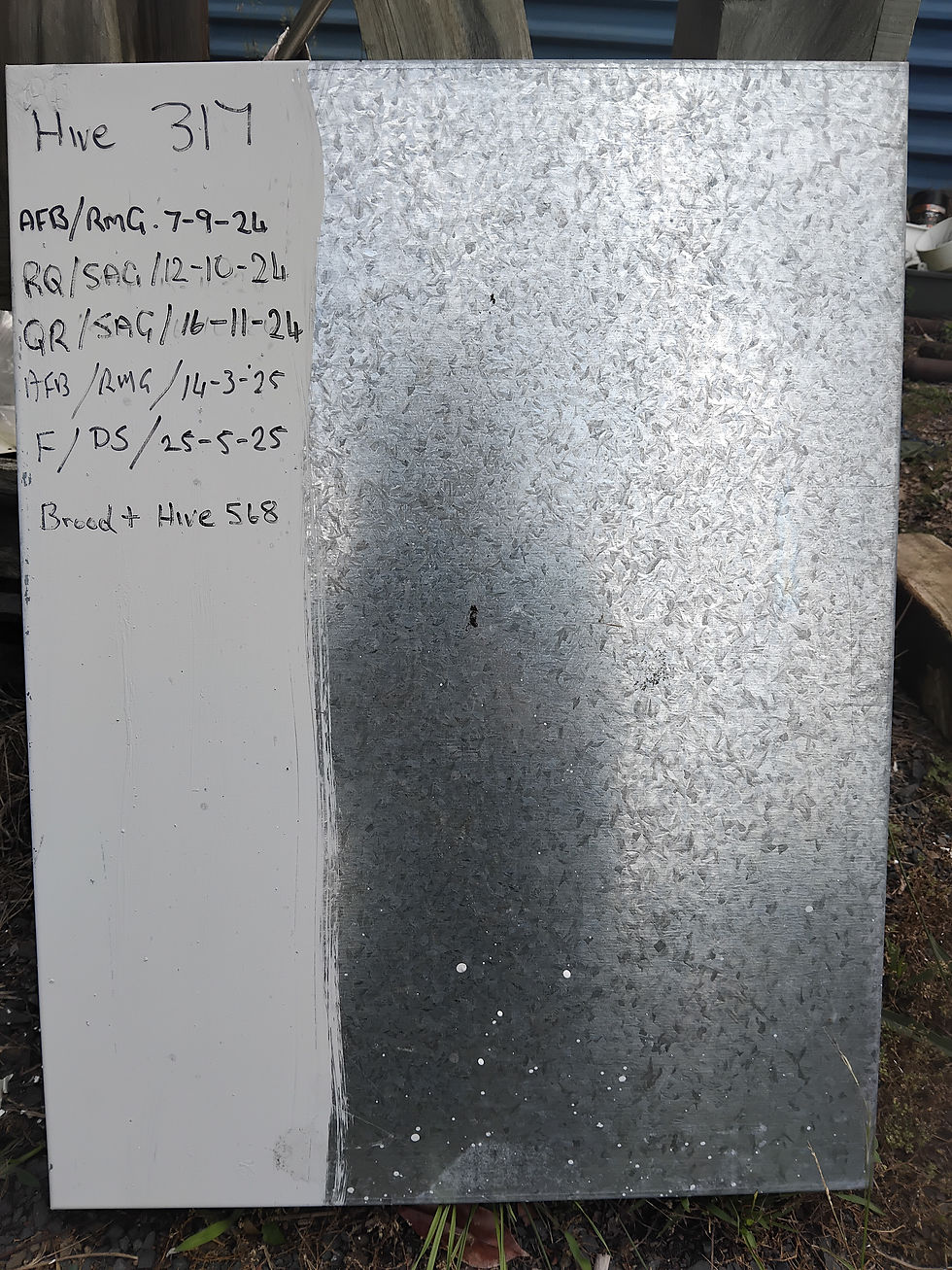
One of the best ways of keeping records is on the hive itself. I have seen a commercial beekeeper doing this with the position of two bricks on the roof. The method is complicated and can get mixed up if anyone else opens a hive.
This can be better achieved by painting a white strip on the roof of each hive. Then everything that is done to the hive can be recorded with the date, the initials of who did it and what was done. It takes a few seconds to record using a black felt pen. A beekeeper can then see a beehives’ history before they open it. For example, in the photo alongside, hive 317 was checked for AFB September 7, Requeened on October 12, found to be queenright 16 November, checked for AFB again in March and supplied hive 568 with brood.
If you use a vivid marker the first entries will fade by the time that the bottom of the strip has been reached, and recording can start at the top again. If you want to keep longer histories of hives you can use a paint pen instead of a vivid.


Comments