
Lower Your Risk of Injury – a Beekeeping-Specific Resource
Updated: May 4
Previously PhD student Jane Pierce’s research has identified the most likely areas of musculoskeletal disorders among beekeepers, now she reports on a recently-developed, free resource which provides an assessment of common beekeeping tasks with the goal of lowering injury risk.
By Jane Pierce
As some of you might know I have been doing a PhD study with Victoria University Wellington, to examine risk factors associated with work-related musculoskeletal disorders (WRMSDs) among apiarists in New Zealand. Musculoskeletal disorders may be felt as aches, pain, discomfort, weakness, or numbness which may interfere with your ability to do your work. Apiculture requires manual work, with physical risk factors such as lifting, carrying and poor postures being part of everyday apicultural work. Calculation of risk is based on the likelihood or probability of the harm being realised and the severity of the consequences.
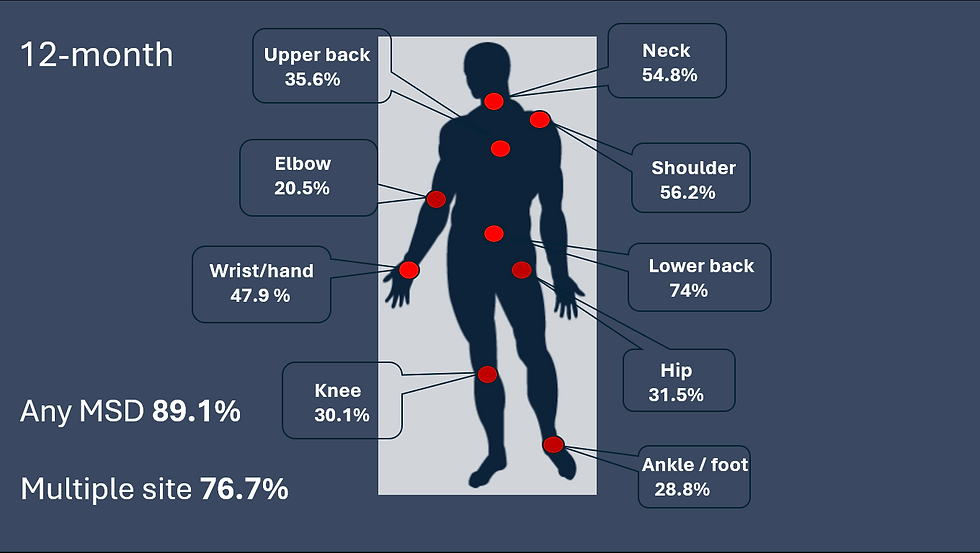
My study showed that apiarists have a high prevalence of WRMSDs, and physical factors were identified by participants as the most likely contributor. One of the important outcomes of my study was the identification of which body parts are affected by musculoskeletal discomfort for apiarists and to what extent. Different agricultural sectors have different results because their work is not the same, so having a general risk management approach was not sufficient to assist in the reduction of musculoskeletal harm.

While discomfort, pain and injury may be seen by many of you as an inevitable part of your job, if not managed well there are consequences which include developing chronic pain, damage which requires medical intervention such as surgery, and increased risk of getting another injury. This will all impact your business, let alone your private life.
A legislative requirement under the Health and Safety at Work Act (2015) is that workplace risks need to be identified, assessed and managed as far as is reasonably practicable. That could be onerous for a small company (as many of you are), as you do not have the time or means to undertake assessments, nor do you have spare funds to contract out your risk management processes. In addition, there are not many resources available for workplaces, especially smaller sectors, to manage their musculoskeletal risks.
Before they were disbanded, the Human Factors Ergonomics team at WorkSafe identified and updated several manual handling risk assessment tools covering a variety of manual handling tasks which are available on their website and are free to use. The NZMAC (New Zealand Manual Handling Assessment Charts) has three sections and covers lifting and lowering, carrying and team handling. The NZART (New Zealand Assessment of Repetitive Tasks) is for tasks which involve repeated movement of the shoulder and arms for loads under 8kg. There is a separate assessment, NZRAPP (New Zealand Risk Assessment of Pushing and Pulling), for tasks which involve pushing and pulling. The Human Factors Ergonomics team also developed some additional resources to assist with assessments such as guidance documents and screening tools to identify which assessment is applicable. You access the resources via this link and, whether it is you or your staff, or both, undertaking such tasks I highly recommend utilising this information.

However, there still appeared to be a gap between the assessment tools and the practical application in a work situation. I collaborated with Leanne Hunter at ProErgo+ who had helped develop the tools at WorkSafe, and we have produced an example of the use of two of the assessment tools (NZMAC for lifting and lowering and NZART) for the task of hive inspection. This is also freely available at this link.
We acknowledge that the example we chose may not be exactly applicable to each apiarist, but the assessments provide examples of practical applications with explanations and are able to be used as templates for your own use. This resource is intended to contribute to the reduction of harm and assist individuals to take care of their own musculoskeletal health management.
If you have any further questions, please feel free to contact myself, mbkstudynz@gmail.com, or Leanne leanne.hunter@proergo.co.nz


Comments