
Mercury Rising


Our time in the orchards has come to an end. Consummation of the kiwifruit means our tempo has slowed. Beekeeping activities are winding down as the temperature rises, and yeah baby, things are heating up.
The red, the gold, and the green are set on the vines, and fields of watermelons are patrolled by armed guards. Pollination was a blast, and a piece of cake, walked through this time by my older brother.

A veteran beekeeper, he’s seen a lot over the years. From bust to boom, he’s been there. Through tormentuous weather events and vandalism, family flare ups and theft, he’s still here. He gets to work with me now. He got to see me almost fall off the deck of the truck, twice in one night. To learn that important lesson without hurting myself, well, someone must be looking out for me.

Unfortunately, and not for the first time, my brother got to see our bees poisoned while in the kiwifruit.
Everybody knows, do not spray while our bees are in the orchard, and everybody talks about saving the bees, but somebody is accountable for spraying the different varieties within the orchard whilst the bees are employed. Sweeping away the dead field bees can’t hide it. Sprays don’t even have to be toxic, it’s the particles, like surfactants, that block the bee’s spiracles. Neighbouring facilities compound the problem. Is it just collateral damage or should there be better liaison between managers? Am I hot around the collar or is it just the weather?

The humidity in the orchards was killer throughout that last task of installing mite control in the hives, but after some big days and nights, our bees are far from home. Pollination units turned free-flow honey gatherers. In general, the hives leaving the orchards were quite light in stores, the constant November rain slowing nectar flows.

Mother nature will do as she pleases.
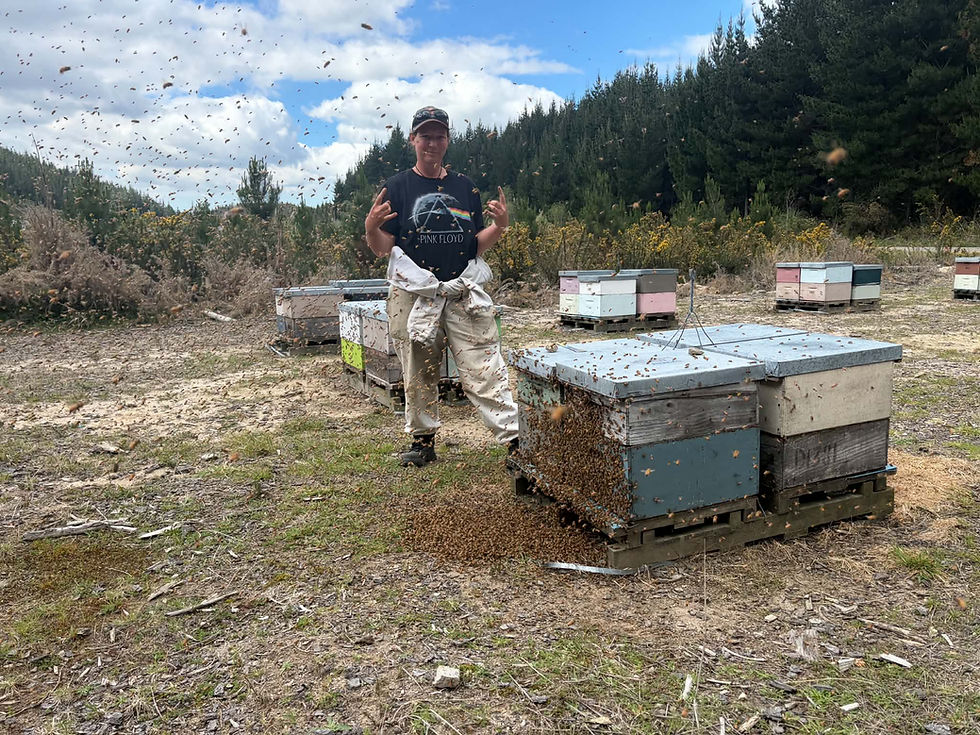
Chasing the sun, our honey sites are micro-climates. Set between Cape Runaway and Waikerimoana, we lay down mileage pursuing the elusive UMF. Hopeful for high counts, but never guaranteed. Honey is money, but pollination is our bread and butter.

What does a beekeeper do while waiting for the sweet stuff to settle in?
Turns out we have a shed-load of gear to sort out, followed by a few fishing trips. Then, in the coming weeks, thousands of honey boxes will be in transit. Preparations are underway in the extracting room, a far cry from last year – the bro and I had already pumped out drums of honey at this time. Slowly it’s sinking in, the only constant in this business is change.

For better, or worse, changes keep you on your toes. Having no beehives around to work is a bit different, as getting personal with a colony is really the highlight of the job. Pre-emptively, I smuggled a hive home, so I can work bees when I’m not working bees…

They’re a joy to watch at least, with a cuppa or a cold one on the back porch. Beneficial to my state of mind and my environment, they change the focus, an everyday reminder to just observe peacefully.
Changes have always been a given, and questions follow. Will the honey flood in this year? Will we survive the season with little to no mite damage? Will our new worker work out? What does the future hold?
Chill, only Mother Nature knows, I’m just a beekeeper.
Relax, into the buzz of summer,
Aimz
Aimz is a second-generation commercial beekeeper in the Bay of Plenty who took up the hive tool fulltime at the end of the 2024 honey season. Formerly a stay-at-home mum to four kids, she has now found her footing in the family business.

Comments