
Dancing Bees – and a Hack to Reduce Robbing
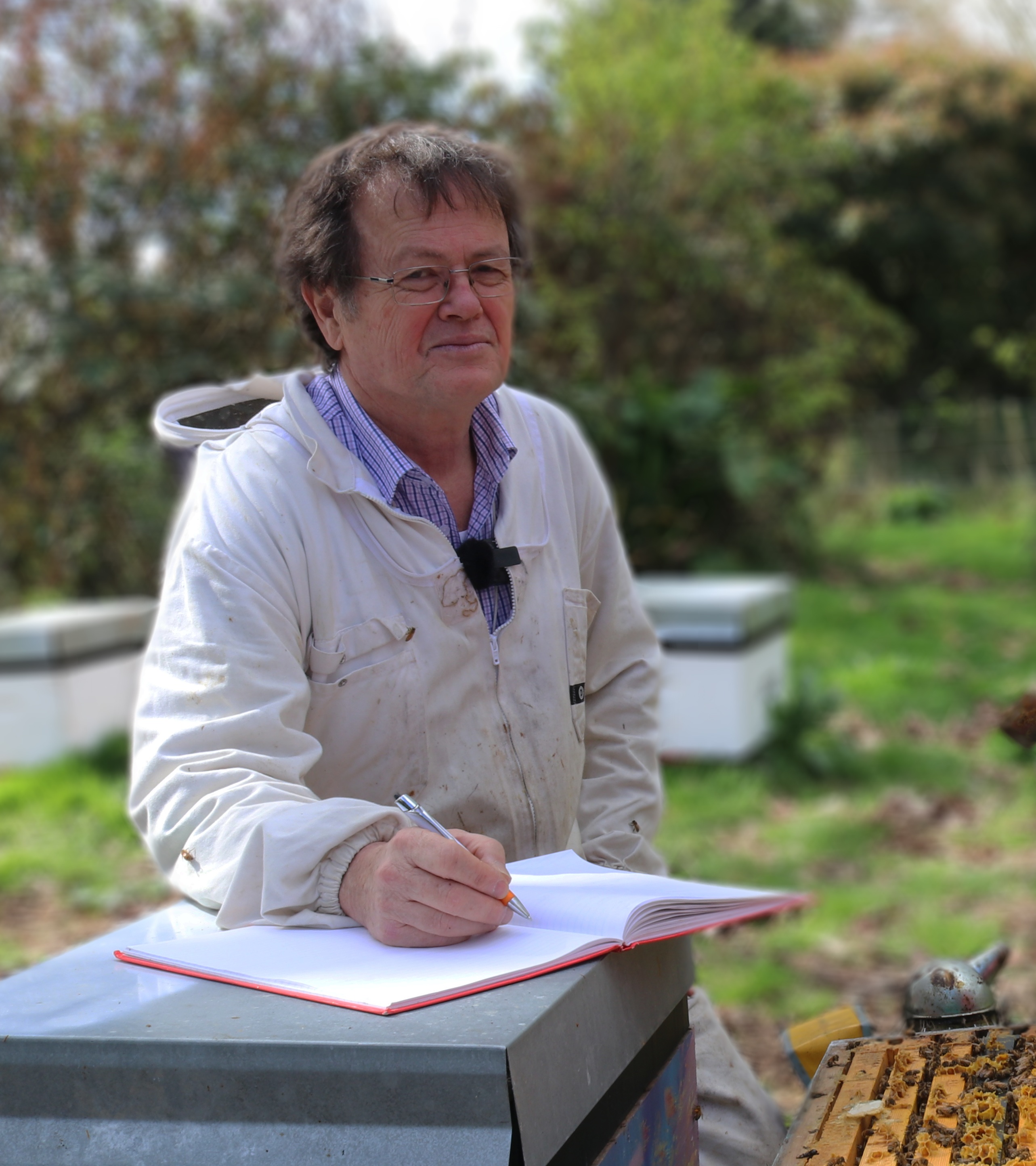
THE SCIENTIFIC BEEKEEPER: DR R. MARK GOODWIN
Most beekeepers are well aware of the ‘waggle’ dance, but did you know honey bees also perform ‘round’ dances? Mark Goodwin has studied the behaviour and determined each of the dances has its own occasion, and that understanding the resulting foraging behaviour can help prevent robbing.
Dr R. Mark Goodwin

Honeybees can recruit other workers to a food source by providing information on what the food smells like, what it tastes like, the attractiveness of the food source, how far the food source is away from the hive, and in what direction.
It had been reported that bees do excited dances inside their hives for about 100 years, but why they did it was a mystery. That was until the 1940s when the purpose of these dances was discovered by German-Austrian ethologist Karl von Frisch. He was awarded a joint Nobel prize with Conrad Lorenz for his work on imprinting, and BF Skinner for his work on operant conditioning.

I could always imagine myself in his lab, when the discovery was made. Von Frisch had trained marked bees from an observation hive, to collect sugar syrup from a dish outside their hive. He noticed that these marked bees ran in circles (round dances) when they returned to their hive. Other bees would follow these dancing bees, which would frequently stop and give their followers a taste of the sugar syrup. These dances are usually done in complete darkness, although you can see these dances being performed on the flight board of very strong colonies, or on the surface of swarms.
He also noticed that unmarked bees were returning to their hive carrying pollen pellets, and were doing a completely different dance (waggle dances). These dancing bees also stopped to give the following bees a taste of what they were carrying.

His first thought was that the different dances were to communicate whether the dancing bees were collecting nectar (sugar syrup) or pollen. A reasonable assumption. For an unrelated reason, Von Frisch started moving the dish of sugar syrup further away from the hive. When it was moved out to 75m, the bees that were doing round dances changed to doing waggle dances. So, the type of dance was not indicating whether the bees were collecting sugar syrup or pollen, but possibly how far the food source was from the hive.
From watching waggle dances, Von Frisch knew bees go through the straight part of the dance and vibrate their abdomen at the same time. Then came the observation that put him on the road to his Nobel prize…

He was recording the angle of the waggle portion of the dances carried out by his marked bees over time, and he noticed that the angle was changing and doing so at 15 degrees per hour. Back then, every scientist knew that the sun’s azimuth changes by 15 degrees per hour. From that, he established that the angle of the waggle portion of the dance relative to gravity, was the same angle the bees had to fly relative to the sun to find the food source.

Exciting stuff, and I will talk about the waggle dance in some further articles. For now, the ‘round’ dance and the resulting question – how do bees get recruited to a food source after following a round dance when it doesn't contain distance and direction information? This is one of the questions I set out to answer in my MSc thesis.
I put 10 scented bee traps in a circle within a 25m radius around a hive. The bee traps would allow bees to enter, but not to leave. I then fed marked bees scented sugar syrup behind one of the bee traps. It did not matter which bee trap I fed the marked bees behind, all the recruited bees were collected in the trap directly upwind of the hive. The same happened when I did experiments with a 50m radius from the hive. All the bees collected in the upwind trap, irrespective of where the marked bees were feeding.
This all changed at 75m, in the area where waggle dances are occurring. Then it didn't matter which way the wind was blowing, all the bees got caught in the trap behind where the bees were being fed, and which was indicated in the waggle dance.
It appears that if bees are bringing back food from distances of 50m or less from the hive, the bees following the dances cannot tell where the food is before they leave their hive. They just leave the hive and hunt for food that smells the same as that carried by the dancing bees.

This is why robbing can be bad within an apiary. If your bee truck is parked in an apiary and bees that got a taste of the honey, their dancing will tell their nest mates that there is a very attractive food source outside their hive, and that it smells of honey. The recruited bees will fly out looking for the smell of honey. Some bees will find the truck, and others may find a neighbouring hive.
If you park you truck downwind of your apiary, some bees will find it, but it would likely be hard for those bees to recruit other bees to your truck.
Mark Goodwin is a honey bee scientist and pollination biologist. He set up and led the honeybee research team at Ruakura in Hamilton for 35 years and has vast experience in beekeeping, having given lectures and worked with beekeepers and growers in 19 different countries, written 25 scientific papers, hundreds of technical articles and some of New Zealand beekeeping’s most instructive books.


Comments